
Have you ever considered that the true depth of a chess match might be found not in the calculation of lines, but in the silent, tactile feedback of the board itself? While many collectors focus exclusively on the grain of boxwood or ebony, the understated elegance of Leather Chess Boards offers a sensory experience that traditional wood often lacks. It's a common frustration to encounter a board that curls stubbornly at the edges or produces a distracting clatter when a heavy, triple-weighted piece is placed with intent.
You likely believe that a serious game deserves a surface that remains perfectly flat and absorbs sound to maintain an atmosphere of quiet study. This guide provides a detailed look at the material nuances and practical benefits of choosing premium hide for your study. We'll examine how these artisan surfaces, rooted in the heritage of the 1849 design, offer a unique durability that allows a board to age gracefully over a 50 year lifespan. Official Staunton remains dedicated to these fine details, ensuring your equipment is as much a piece of functional history as the game itself.
For the dedicated player, the moment a hand rests upon a chess piece marks the beginning of a profound mental journey. Choosing Leather Chess Boards over traditional wood or stone isn't merely a stylistic preference; it's a commitment to a specific tactile experience that changes the nature of the game. When a triple-weighted Knight, perhaps one weighing over 60 grams, meets the yielding surface of a hand-tanned hide, the response is immediate and sophisticated. This interaction creates a physical connection to the board that rigid materials often lack.
While the broader scope of Chessboard materials and history highlights the utility of wood and marble, leather introduces an organic warmth that feels alive beneath the fingertips. The natural variation in the hide ensures that no two squares are identical, providing a visual depth that complements the intricate carving of a 1849 Staunton pattern set. This organic quality turns the board into a piece of functional art, inviting the player to linger over their next move.
To see the level of precision and artisan skill required in high-end leatherwork, this demonstration of traditional stitching techniques is quite illuminating:
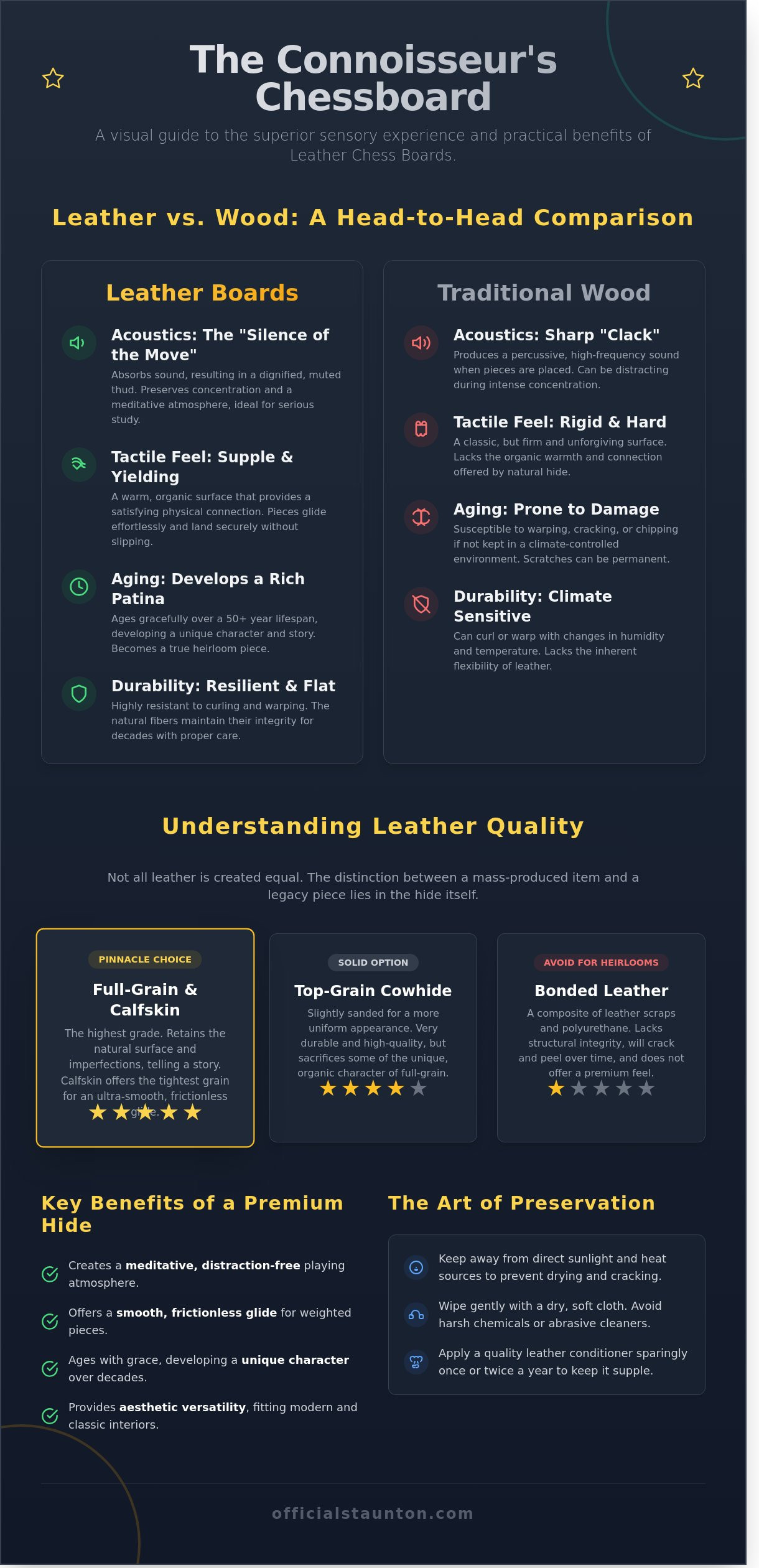
Professional calculation requires an almost monastic level of concentration, and the acoustics of the room play a vital role in this focus. The sharp, percussive clack of a piece landing on a wooden board can, for some, break the delicate thread of a ten-move variation. Leather absorbs this energy, turning a forceful move into a dignified, muted thud that signals intent without causing distraction. This dampening effect is particularly noticeable with triple-weighted pieces, where the lead-filled bases find a secure, non-slip home on the supple surface.
A leather board acts as a bridge between different eras of interior design. It fits as comfortably in a minimalist glass-walled office as it does in a mahogany-lined library. The hand-stitched borders, which often involve hundreds of individual punctures by a master artisan, frame the field of play with a level of detail that commands respect. Beyond the expected browns, deep oxblood hues or classic English tan shades provide a palette that wood simply cannot replicate. This allows the Leather Chess Boards to become a central design element that reflects the owner's personal taste.
Another factor worth considering is how the material ages over decades of use. Unlike vinyl which may crack or wood that might warp if not kept in a climate-controlled room, high-quality leather develops a unique patina. This transition from a competitive match to a luxurious, intellectual ritual is what defines the Official Staunton experience. It's a reminder that chess is as much about the beauty of the instruments as it is about the logic of the moves.
Selecting a leather chess board requires an eye for the subtle distinctions that separate a mass-produced item from a legacy piece. At the summit of this hierarchy sits full-grain leather, which retains the natural surface of the hide, including the unique imperfections that tell the story of the animal's life. Top-grain varieties offer a more uniform appearance through slight sanding, yet they sacrifice a fraction of the organic soul found in full-grain. The discerning collector should avoid bonded leather; it is essentially a composite of scraps held together by polyurethane, lacking the structural integrity required for a serious heirloom.
For the player who values the fluid movement of a triple-weighted knight, calfskin represents the pinnacle of surface texture. Its tighter grain and inherent softness provide a friction-less glide that traditional cowhide, while durable, cannot quite replicate. This tactile superiority is often why master artisans prefer calfskin for professional Leather Chess Boards. To truly appreciate this level of detail, one might consult a Connoisseur’s Guide to Tactile Luxury, which illustrates how material choice elevates functional objects into the realm of fine art.
The longevity of these boards depends heavily on the tanning process. Vegetable tanning, an ancient method using tannins found in tree bark, ensures the leather remains supple for decades without the chemical brittleness associated with chrome-tanned alternatives. You can identify genuine craftsmanship by examining the perimeter. Hand-painted edges and saddle stitching, where two needles pass through each hole, create a structural bond that won't unravel like a machine-sewn lockstitch. If you are seeking a surface that reflects this level of dedication, you might consider exploring the exquisite leather collections curated by our master craftsmen.
While the purist may insist on hide, high-quality leatherette serves a practical purpose for the traveling player or the club environment where spill resistance is paramount. Modern eco-leathers have advanced significantly since 2010, offering a premium feel that mimics genuine textures. However, synthetics remain static. They don't breathe, and they certainly don't develop the rich, amber patina that makes decades-old Leather Chess Boards such cherished companions. Another factor worth considering is that genuine leather adapts to its environment, whereas plastic-based alternatives eventually crack under the same pressures.
A common frustration with inferior leather goods is the tendency to curl at the corners due to atmospheric humidity. To prevent this, professional-grade boards are bonded to a stabilizing core, often a thin layer of tempered wood or specialized resin. This core must be thick enough to maintain a perfectly level playing field while remaining thin enough to preserve the board's elegant profile. A thickness of 3mm to 5mm is generally considered the "sweet spot" for balancing portability with structural permanence. This leads to an interesting point: the weight of the leather itself acts as a stabilizer, meaning a heavier hide often results in a more reliable playing surface during intense matches.
Choosing between a solid wood board and a leather alternative isn't merely a matter of aesthetics; it's a decision about how one intends to interact with the game. While a heavy mahogany or ebony board commands a room like a piece of fine Victorian furniture, high-quality Leather Chess Boards offer a tactile resilience that timber simply cannot replicate. Wood is prone to hairline fractures or surface scratches from a dropped knight, yet leather tends to absorb these "battle scars," integrating them into its character rather than suffering from them. It's an interesting paradox where the softer material often proves more durable in the face of frequent, competitive play.
Maintenance requirements differ significantly between these two traditional materials. A wooden board requires periodic waxing and polishing to prevent the grain from drying out or losing its lustre, whereas hide demands a more focused approach to maintain its suppleness. For those dedicated to the longevity of their collection, understanding The Art of Preserving a Leather Masterpiece is essential. Proper conditioning ensures the leather remains pliable for decades without the risk of cracking, a process that feels more like caring for a living heirloom than maintaining a static object.
In the heat of a blitz game, the "slide" of a triple-weighted piece feels distinct on leather. There's a subtle, controlled friction that provides more grip than the often-slick lacquer of a polished wooden surface. Environmental factors also play a role; wood is notoriously sensitive to humidity, often warping if levels fluctuate beyond the ideal 40% to 50% range. Leather is far more forgiving in this regard, making it a superior choice for the travelling player. Additionally, the natural "rebound" of leather acts as a cushion, protecting delicate, hand-carved manes or coronets from chipping during a vigorous exchange.
There's a certain gravitas to Leather Chess Boards that have aged over ten or twenty years. While wood remains relatively static, leather evolves, developing a unique patina that tells the story of every match played. Collectors often view their wooden boards as the "throne" for their pieces at home, while the leather mat becomes the essential equipment for the club or the study. This leads to an interesting observation: many connoisseurs own both, using the wooden board for display and the leather for the rigours of deep study. It's a question of legacy; a well-cared-for leather board carries the weight of history in its very texture, becoming a weathered companion that feels more personal with every passing generation.
One cannot overlook the sheer practicality of the roll-up leather format. It offers the prestige of a luxury material with the convenience of a portable mat, allowing the Official Staunton experience to be transported with ease. Investing in leather is an investment in versatility. It's the choice of the player who values the quiet authority of a material that doesn't just sit on a table, but lives and breathes alongside the game, maturing into a piece of functional art that is as much about the touch as it is about the tactic.
Choosing the right set of men for a leather board is a task that requires an eye for both tonal harmony and tactile response. While a wooden board offers a rigid, uniform surface, Leather Chess Boards possess a subtle "give" and a unique grain that demands a specific type of piece. For instance, the deep, obsidian hues of genuine Ebony pieces pair exquisitely with a Tan or Cognac leather surface; the dark wood draws out the warm undertones of the hide, creating a visual depth that is difficult to achieve with lighter timbers.
Another factor worth considering is the interaction between the base of the piece and the texture of the leather. Unlike the glassy finish of a lacquered board, leather provides a degree of natural friction. This makes the quality of the base felting paramount. We recommend pieces finished with heavy-duty billiard cloth or premium leather pads to ensure they glide effortlessly without catching on the natural pores of the board. For those looking to create a permanent installation in a study or library, integrating these boards with a dedicated chess table transforms the game into a focal point of the room's architecture.
The timeless silhouettes of staunton chess pieces remain the most prestigious companion for a leather playing field. To evoke a truly Victorian atmosphere, one might pair our Morphy Series with a classic oxblood leather board; the rich reds of the leather complement the intricate carving of the knights. If your tastes lean toward a more contemporary aesthetic, the Fischer Spassky series, known for its robust and minimalist profile, sits perfectly upon a sleek black leatherette surface, offering a stark and professional look that mirrors the intensity of world championship play.
Proportion is the secret to a balanced board. A 2.25-inch square is often preferred for tournament-sized pieces, as it provides enough breathing room to appreciate the craftsmanship of the carving. However, on a leather board, the width of the border also plays a significant role in directing the eye. A wider border acts as a frame, grounding the supple surface and preventing the field from appearing cluttered. We also find that triple-weighted bases are essential here; the added mass provides a satisfying "thud" and ensures stability on the slightly textured surface of the leather. This weight prevents pieces from tipping if the leather has any minor, natural undulations.
Owning a fine leather board is much like maintaining a vintage leather-bound library; it requires a gentle touch and an understanding of the material's organic nature. For routine cleaning, you should steer clear of any household detergents or abrasive chemicals. These substances strip away the natural oils that keep the surface supple and can cause irreversible discolouration. A slightly dampened, lint-free cloth is usually all that's required to lift away the remnants of a long afternoon of play. If a spill occurs, the secret is to blot the liquid immediately with a dry cloth rather than rubbing it into the grain. Vegetable tanned leather is particularly absorbent, so acting within thirty seconds can prevent a permanent watermark from forming on your investment.
To prevent the leather from becoming brittle or cracking over the years, applying a high-quality leather balm once every six months is a wise practice. This nourishes the hide and maintains that distinctive, rich aroma that collectors find so intoxicating. When you consider storage, the ideal scenario is to leave the board lying flat on a table or in a dedicated drawer. If space is at a premium and you must roll it, always ensure the playing surface faces outwards. This technique prevents the leather from developing unsightly creases or memory curls that could disrupt the stability of your pieces during a match. Have you ever noticed how a poorly stored board refuses to lie flat? That is exactly what we want to avoid.
Positioning your board away from direct sunlight is crucial for its longevity. UV rays are notorious for bleaching the deep pigments out of premium hides, often causing noticeable fading within just twelve weeks of constant exposure. You might also notice pressure rings where heavy, triple-weighted pieces have sat for extended periods. A soft, circular massage with a clean fingertip or a dry microfiber cloth can often encourage the fibres to settle back into place. For daily maintenance, a quick wipe with a dry cloth prevents dust from settling into the fine pores of the leather, keeping the finish as vibrant as the day it left our workshop.
At Official Staunton, we approach the selection of hides with the same meticulous rigour we apply to our wooden chess boards. Each piece of leather is inspected for grain consistency and thickness to ensure it meets the exacting standards of the 1849 Staunton legacy. We believe that a chess board should be more than a utility; it should be a sensory experience that rewards the player's touch. Choosing one of our Leather Chess Boards is an investment in a quiet, tactile form of luxury that only improves with age. It remains the thoughtful choice for the player who understands that the weight of a grandmaster's move is best felt on a surface that carries its own history and soul.
Choosing a playing surface is about more than just aesthetics; it's about the quiet, tactile satisfaction of a piece meeting the refined grain of premium calfskin. We've explored how high quality leather provides a cushioned response that traditional wooden boards can't replicate, making every move feel intentional and weighted with historical significance. Since 1993, Official Staunton has dedicated itself to these fine details, ensuring that the integrity of the original 1849 design remains preserved in every hide we select.
It's quite remarkable how a well-maintained board develops its own distinct character over decades of careful play. As official custodians of the Staunton legacy, we understand that a board isn't just a purchase but a stewardship of the game's rich history. Whether you're drawn to the deep scent of traditional hides or the precision of modern alternatives, your choice reflects a commitment to intellectual prestige. We provide worldwide shipping for serious collectors who seek to pair their grandmaster sets with a surface of equal calibre.
We invite you to explore our exquisite collection of Leather Chess Boards and discover a piece that resonates with your own sense of heritage. There's a profound joy in knowing that your chosen board will only grow more distinguished with every game you play.
Genuine leather chess boards are remarkably resilient and often outlast their wooden counterparts when subjected to the rigours of daily play. A premium hide, typically sourced from European tanneries, possesses a natural elasticity that resists the surface cracking seen in cheaper materials. Most professional grade boards feature a thickness of 2.5 millimetres, ensuring the playing surface remains supple yet sturdy through decades of use. It's a material that actually improves with age, acquiring a unique patina that marks the history of your games.
A well-crafted leather board will lie perfectly flat, provided it has been tanned and weighted correctly by an artisan. While inferior, paper-thin alternatives may suffer from curling at the edges, our hides are heavy enough to maintain their profile. If you've kept a board rolled for a long period, simply placing it on a flat surface for 15 minutes usually allows the natural fibres to relax. This inherent stability is why serious players prefer them over plastic or vinyl options.
The best method for maintaining a leather board involves using a soft, slightly damp microfibre cloth to gently lift away dust. If a deeper clean is required, a pH-neutral leather soap, such as those used in fine bookbinding, should be applied sparingly to avoid over-saturating the hide. You should never use harsh household detergents, as these strip the natural oils that keep the surface supple. Treating the board every 12 months with a high-quality conditioner will preserve its lustre for a lifetime.
You can certainly use any set of pieces, though the tactile experience is greatly enhanced when paired with triple-weighted Staunton pattern chessmen. The soft, yielding nature of the leather provides a satisfying thud during play that you won't find on a wooden board. It's vital to ensure your pieces have high-quality billiard cloth or felt bases to prevent unnecessary abrasion. Many collectors find that 3.75-inch kings provide the perfect visual balance on a standard 55-millimetre square leather board.
Leather chess boards often occupy a middle ground, typically priced between £80 and £250, making them more accessible than premium solid ebony or rosewood cabinets. While a basic veneer board might cost less, the artisan craftsmanship required to hand-stitch and emboss leather justifies the investment. When you consider that a high-quality leather surface can last 50 years or more, the cost per game becomes negligible compared to mass-produced alternatives. It's a choice that balances luxury with practical longevity.
There's a vast difference between genuine hide and synthetic leatherette, primarily in terms of breathability and tactile feedback. Leatherette is essentially a plastic coating over fabric which tends to peel or flake after about 3 to 5 years of regular use. In contrast, genuine leather is a natural, organic material that breathes and adapts to its environment. You'll notice the difference immediately in the scent and the way the board grips the table surface during a tense blitz match.
Genuine leather boards possess a distinct, pleasant aroma that is often associated with luxury libraries or high-end saddlery. This scent is a hallmark of the vegetable tanning process and typically mellows over the first 12 months rather than becoming unpleasant. Unlike synthetic materials that may off-gas chemical odours, a real leather board maintains a subtle, earthy fragrance that many enthusiasts find adds to the atmosphere of the game. It’s part of the sensory experience that makes leather so appealing.
Leather boards are frequently chosen for professional settings because they provide a non-reflective surface that reduces eye strain under tournament lighting. The 1972 World Championship highlighted the importance of matte surfaces for player focus. Additionally, the sound-dampening qualities of leather ensure that the clack of pieces doesn't distract competitors in a quiet hall. Their ability to be rolled up and transported without the risk of warping makes them a practical choice for grandmasters on the move.
