
To the uninitiated, a knight is merely a carved block of wood, yet to the connoisseur, it represents a silent testament to the 1849 Victorian revolution in functional art. You've likely felt that subtle pang of disappointment when chess pieces feel too light in the hand or when the grain of the wood doesn't match the gravity of your next move. It's a common frustration to find oneself lost amidst vague descriptions of timber or uncertain about the true meaning of a triple-weighted base.
This guide promises to demystify the meticulous artistry and technical nuances that elevate these objects into enduring masterpieces of design. We'll explore the profound history of the Staunton legacy, providing you with the expertise to distinguish between genuine artisan carving and the soulless uniformity of mass production. As custodians of this heritage, Official Staunton ensures you'll gain a deep understanding of how to identify authentic historical designs and the practical steps needed to care for exquisite fine woods.
We'll begin by tracing the architectural origins of the classic pattern before examining the tactile details that define a premium playing experience.
Chess pieces are the physical tokens representing a royal court on a 64-square battlefield. To the dedicated player, a chessman is rarely viewed as a mere utility. It serves as a vessel where strategic intent meets artistic expression; a bridge between the cold logic of the game and the tactile warmth of fine boxwood or ebony. A standard set comprises sixteen pieces for each side, creating a balanced symmetry that has defined the geometry of conflict for centuries.
This traditional composition ensures that every engagement on the board is a reflection of historical hierarchy. The transition from the abstract, often fragile shapes of the Middle Ages to our modern standards represents a significant maturation of the game. It’s a journey from decorative curiosity to functional masterpiece, where the weight and form of the chess pieces are as vital as the moves they execute.
The hierarchy of the board is revealed through specific architectural and symbolic cues that have been refined over generations. The King and Queen command the most presence, distinguished by their superior height and the intricate detail of their respective coronets. One finds the Bishop defined by the deep cleft of the liturgical mitre, while the Rook stands as a miniature fortress with its distinct battlements.
The Knight, often the most expressive carving in a set, represents the cavalry through its arched neck and flared nostrils. In contrast, the humble Pawn stands as the steadfast infantry of the front line. These roles are not merely symbolic; they provide the visual shorthand necessary for a player to scan the board and calculate complex variations in an instant.
Before the mid-nineteenth century, the landscape of competitive play was remarkably fractured. Players often struggled with the abstract and spindly forms of the St. George or the overly ornate Selenus patterns, which frequently led to confusion during the heat of a tournament. This lack of a universal design language made the 1849 introduction of the Staunton pattern a necessity rather than a luxury.
It replaced the erratic heights and fragile limbs of earlier sets with a robust, figurative art that allowed for immediate recognition across all borders. The tactile weight of these historical designs reminds us that, before the 1849 standard, the game was as much a test of visual focus as it was of mental acuity. Choosing a set today is an act of connecting with that heritage, ensuring the physical tools of the game match the gravity of the intellectual pursuit.
The year 1849 marked a definitive turning point for the game, as it saw the birth of a design that would transcend mere utility to become the global language of the board. Before this era, players grappled with a chaotic variety of chess pieces, from the spindly Barleycorn to the overly decorative St. George pattern, which often proved too fragile or top-heavy for rigorous use. The collaboration between the designer Nathaniel Cook and the preeminent English master Howard Staunton addressed these frustrations by introducing a set that was both aesthetically pleasing and remarkably functional. This standardisation served as the essential catalyst for the first international chess tournaments, most notably the London 1851 event, where a uniform aesthetic was required to ensure fair play among diverse competitors. It's for this reason that the World Chess Federation, known as FIDE, has permitted only the Staunton pattern for official competition since its inception in 1924.
Another factor worth considering is how the design balanced elegance with durability; the pieces were crafted to withstand the physical demands of play while maintaining the grace of a Victorian drawing room. The weight was concentrated at the bottom, a departure from the precarious designs of the past, ensuring that a stray sleeve would not easily upend a complex position. This marriage of form and function has allowed the pattern to remain the gold standard for over 175 years.
The Neoclassical roots of the columns and bases reflect the architectural sensibilities of the 19th century. One can observe how the London skyline of the 1840s directly informed the profile of the Rook, echoing the sturdy battlements of the Tower of London. Perhaps most striking is the Knight, whose fierce, muscular expression was meticulously modelled after the horses found on the Elgin Marbles, which had been acquired by the British Museum in 1816. This connection to classical antiquity lent the game an air of intellectual prestige that appealed to the Victorian elite.
Discerning collectors look for the wide, stable bases that prevent tipping during frantic blitz games, a hallmark of superior chess pieces. The King is distinguished by his formal collar and cross patonce, while the Bishop features a deep mitre-cut topped with a delicate ball. For those seeking a deeper understanding of these nuances, exploring the history of staunton chess pieces reveals the profound heritage behind each hand-carved element.
The enduring appeal of this design lies in its perfect proportions, where every curve serves a purpose. If you're looking to elevate your own study, you might consider browsing the exquisite collections at Official Staunton to find a set that resonates with this rich history. The weight of a piece should always match the weight of the moment, and few designs command respect quite like a true Staunton set.
To hold a piece of genuine Ebony is to understand the weight of history itself. This dense, lustrous timber has occupied the highest tier of the material hierarchy since the original 1849 Staunton sets were first turned in London. Its natural oils and incredible density provide a weight that synthetic alternatives simply cannot replicate, offering a tactile gravity that anchors each move. While lesser sets might use ebonised boxwood, the connoisseur seeks the deep, midnight black of solid Diospyros celebica, a wood so heavy it barely floats in water.
The companion to this dark majesty is almost always Boxwood (Buxus sempervirens). This specific timber is prized by master carvers for its remarkably tight grain and uniform density, which allows for the intricate, microscopic detail required in a Knight’s mane or a King’s crenellated crown. Boxwood has been the preferred "white" side material for over two centuries because its natural pale hue offers a perfect visual contrast to darker hardwoods while remaining incredibly durable under the constant handling of tournament play. There is a distinct warmth to natural wood that plastic lacks; it absorbs the ambient temperature of the room and the heat of the player's hand, creating a sensory connection between the strategist and their chess pieces.
A serious player judges a set by its stability as much as its beauty. To achieve this, artisans carefully hollow the base of each piece to insert lead or steel weights, a process known as triple-weighting that lowers the centre of gravity significantly. This ensures that even a tall, elegant Queen will not topple if brushed accidentally during a time scramble. There is also the psychological impact of the "thud" factor; the resonant, authoritative sound of a weighted piece meeting the board signals a move made with absolute conviction. Balancing these weights requires a steady hand, as an over-weighted piece can feel cumbersome, losing the nimble grace required for rapid play.
The final character of a set is determined by its surface treatment. While modern high-gloss lacquers provide a mirror-like shine, many traditionalists prefer the understated elegance of a natural wax polish. This "piano finish" is achieved through hours of meticulous hand-buffing, allowing the natural grain of the timber to breathe and develop a rich patina over decades of use. To protect the delicate surfaces of high-quality wooden chess boards, the base of each piece is finished with heavy-duty billiard cloth or premium leather pads. These soft foundations allow chess pieces to glide across the squares with a silent, ghostly smoothness that respects the quiet intensity of the grandmaster’s environment.
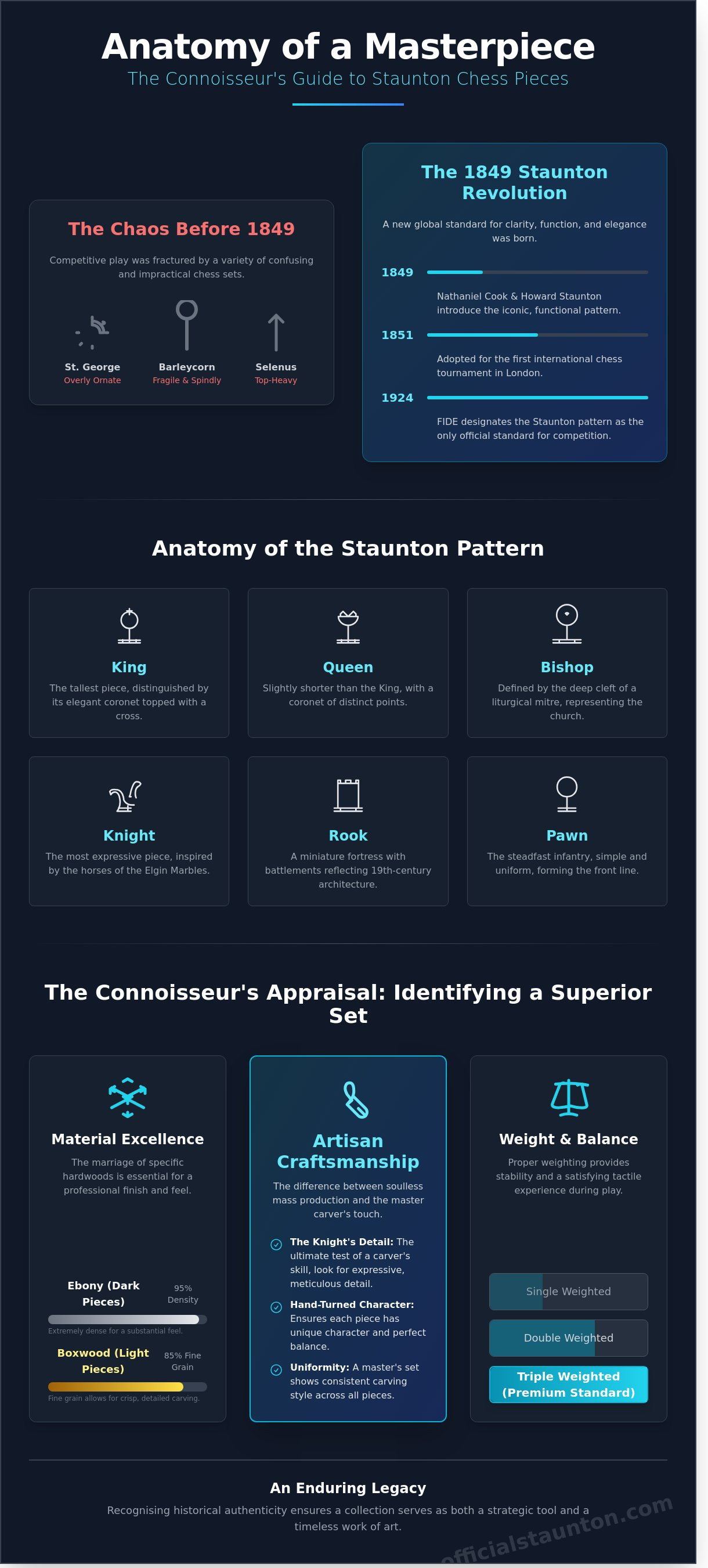
To the discerning collector, a set of chess pieces represents far more than a mere instrument of play. It is a sculptural dialogue between the woodturner's lathe and the carver's chisel. When you begin evaluating a high-end set, the Knight serves as the ultimate litmus test for quality. Because it is the only piece that cannot be formed purely by turning, its execution reveals the true skill of the artisan. A master carver ensures that all thirty-two pieces exhibit a level of uniformity that feels intentional, where every mitre cut on a Bishop and every crenulation on a Rook is a mirror image of its counterpart.
A connoisseur looks for specific hallmarks in the Knight's expression and posture. You might find yourself choosing between the "Marshall" style, known for its aggressive, flared nostrils and defiant mane, or the more reserved "Morphy" style that echoes classical Greek sculpture. The finest examples showcase individual hair strands carved into the mane and a lifelike curvature to the neck that suggests motion. For those who appreciate this level of historical accuracy, The Marshall Series Chess Pieces provide a definitive look at how these American classics are brought to life through meticulous hand-carving. It is in these tiny details, such as the flare of a nostril or the set of a jaw, that the soul of the set is found.
While aesthetic beauty is paramount, these objects are intended for the rigours of the 64 squares. The "tournament size" King, standing at 95mm (3.75 inches), has become the global standard for serious study and competitive play. It offers the perfect tactile presence without obstructing the player's view of the board. Another factor worth considering is the delicate balance between detail and resilience. Over-carving can lead to a "fragile beauty," where pieces become too delicate to handle during a blitz game. A well-proportioned set ensures that even the most intricate features are robust enough to survive decades of use, improving the ergonomics of a long, five-hour match.
This leads to an interesting point regarding the geometry of the board itself. To maintain visual clarity during a complex middle-game, the King’s base should ideally occupy between 75% and 78% of the square’s width. If the chess pieces are too wide for the squares, the board feels suffocated; if they're too narrow, the set loses its authoritative presence. Achieving this mathematical harmony is what separates a standard set from a masterpiece of functional art.
The creation of a truly superior chess set is a slow, deliberate process that defies the frantic pace of modern manufacturing. While many mass-market producers have turned to CNC machining to churn out identical, characterless shapes, the artisan approach remains anchored to the traditional lathe. Hand-turning allows a master carver to respond to the unique temperaments of the timber, adjusting their tools to the specific density and grain of each block. This human touch ensures that every one of the chess pieces possesses a subtle individuality that machine-led processes simply cannot replicate. It is the difference between a cold industrial product and a soulful instrument of play.
Official Staunton remains steadfastly committed to the 1849 design specifications, a standard that transformed the game during the Victorian era. By adhering to the precise proportions and aesthetic nuances of the original Staunton design, as conceptualized by Nathaniel Cook, we ensure that its historical integrity is never diluted. When you hold a King from our collection, you are feeling the same balance and silhouette that was honoured by masters like Howard Staunton himself. Collectors play a vital role here; they act as custodians of this functional art, ensuring that these designs endure for another century. A well-chosen set isn't a temporary purchase, it's a future heirloom that will carry the stories of your most intense matches down to your children and grandchildren.
Owning a premium set requires a commitment to preservation, particularly when dealing with dense timbers like Ebony. This wood is notoriously temperamental and can develop small "checks" or cracks if the environment becomes too dry. We recommend maintaining a stable humidity level between 40% and 55% to keep the wood supple. To clean your set, avoid any harsh chemical polishes that might strip the natural oils. A simple, dry microfibre cloth is usually sufficient to maintain the lustre of your luxury chess sets, ensuring they remain in pristine condition for decades of serious study.
Every series we produce undergoes a rigorous inspection process where we oversee the carving and weighting of every individual piece. We meticulously source our Boxwood and Rosewood from sustainable plantations, selecting only the finest heartwood for our premium lines. For those who possess damaged antique sets, our restoration services can breathe new life into 19th-century treasures, matching grains and patinas with historical accuracy. There is a quiet authority in a perfectly weighted King as it sits on the board, a physical manifestation of the gravity and intellectual depth that the game demands. It is this weight, both literal and historical, that defines the Official Staunton experience.
Selecting a set isn't just about utility; it's about connecting with a history that spans nearly two centuries. The enduring appeal of the 1849 Staunton pattern lies in its perfect marriage of form and function, where the tactile weight of triple-weighted ebony meets the delicate carving of a knight's mane. These aren't merely chess pieces; they're functional heirlooms that carry the quiet authority of Victorian craftsmanship into the modern study. For over 30 years, Official Staunton has dedicated itself to this singular standard, employing master artisans who use traditional techniques to ensure every set meets the rigorous demands of collectors and grandmasters worldwide.
When you hold a piece that's been turned and polished with such meticulous care, the game itself feels more profound and deliberate. Every grain of boxwood and every felted base represents a commitment to an art form that refuses to be rushed by the modern world. We invite you to explore our exquisite collection of handcrafted chess pieces at Official Staunton and find a set that resonates with your own appreciation for heritage. There's a particular, lasting satisfaction in owning a masterpiece that's built to endure for many generations of play.
A standard set consists of exactly 32 chess pieces, with each player commanding an army of 16. This collection includes one king, one queen, two rooks, two bishops, two knights, and eight pawns for each side. While many of our premium collections include two additional queens to accommodate pawn promotion, the historical 1849 specification remains the foundation for any serious set intended for competitive or study purposes.
The individual figures in a set are known as the King, the Queen, the Rook, the Bishop, the Knight, and the Pawn. Each of these chess pieces possesses a distinct silhouette that was refined during the Victorian era to ensure they were easily recognisable during the heat of battle. The Knight is often considered the piece that defines a set's character, as it's the only figure that requires extensive hand-carving rather than simple turning on a lathe.
The King is the most vital piece on the board because its capture, or checkmate, signifies the immediate end of the game. While the Queen is the most powerful in terms of movement and tactical range, the King's safety is the singular objective around which every strategy revolves. In professional sets, the King typically stands between 3.75 and 4.4 inches tall, serving as the majestic focal point of the entire ensemble.
These sets are named after Howard Staunton, the English chess master who was the unofficial world champion from 1843 to 1851. In 1849, Nathaniel Cook designed this specific pattern to replace the fragile and overly ornate designs that were common at the time. Staunton endorsed the design for its stability and clarity, and it has since become the only pattern recognised by the International Chess Federation for use in official tournaments.
For a set of heirloom quality, you can expect to invest anywhere from £150 to over £1,200 depending on the rarity of the timber and the intricacy of the carving. A triple-weighted set crafted from genuine Ebony and Boxwood typically begins at the £250 mark in the United Kingdom. This price reflects the 40 to 60 hours of artisan labour required to hand-turn, carve, and polish each piece to a professional standard.
It's often possible to source individual replacements from specialist purveyors like Official Staunton to ensure your cherished set remains complete. Because high-end pieces are hand-carved, matching the specific grain and patina of a set purchased ten years ago requires a discerning eye. It's helpful to provide the base diameter of your existing pieces, as a standard tournament King usually measures around 45mm at the base to fit a 55mm square board.
Genuine Ebony and Boxwood are widely regarded as the pinnacle of materials for serious play due to their exceptional density and natural lustre. Ebony provides a deep, natural black that doesn't require artificial staining, while Boxwood offers a tight grain that allows for the meticulous detail found in a Knight's mane. Another factor worth considering is the use of Bud Rosewood, which offers a rich, crimson hue that develops a magnificent depth over several decades of use.
You should maintain your pieces by gently buffing them with a soft, lint-free microfibre cloth to remove the natural oils transferred from your hands during play. Every year or two, applying a small amount of high-quality Renaissance Wax will preserve the timber's moisture balance and protect the hand-polished finish. This leads to an interesting point about storage; you should always keep your set away from direct heat sources or damp environments, as extreme fluctuations can cause the wood to swell or crack around the lead weights.
