
What if the most effective antidote to the frantic pace of the digital age was not a new application, but a masterpiece of functional art meticulously carved from boxwood and ebony? A 2022 survey indicated that approximately 65% of adults feel overwhelmed by daily screen time, which explains why using a premium chess set as a mindfulness tool has become such a compelling prospect for the modern connoisseur. It's a common struggle to find a hobby that feels both intellectually stimulating and physically grounding in such a fragmented environment.
You'll discover how the tactile weight of an artisan-carved piece can serve as a powerful anchor for your attention, pulling you away from the digital noise. This article explores how the ritual of the game, rooted in the 1849 Staunton tradition, allows you to slow down time and cultivate a profound sense of presence. We'll examine how the sensory experience of handling triple-weighted pieces provides a unique path to cognitive resilience, turning a classic game into a restorative practice for the mind.
To the uninitiated, a game of chess appears as a cold, calculating battle of logic. However, for those who appreciate the weight of a triple-weighted piece and the grain of fine boxwood, the experience is far more profound. Using a chess set as a mindfulness tool transforms the game into a practice of active presence. This state of being requires the player to inhabit the current moment entirely, where the only reality that exists is the geometric relationship between thirty-two figures and sixty-four squares. It is a rare form of mental stillness found through intense activity.
The physical board serves as a bounded reality. Within its perimeter, the chaotic noise of external life is silenced. This intentional limitation of space allows the mind to settle into a singular focus that is often impossible to achieve in other areas of life. The 1849 Staunton design, with its meticulous proportions and Victorian architectural influences, provides a sense of order that anchors the player. When you handle a piece from our Staunton reproduction chessmen collection, you are not just playing a game; you are engaging with a historical continuity that commands respect and quiet contemplation.
Mihaly Csikszentmihalyi, the psychologist who defined the "flow state," often pointed to chess as the ultimate example of this phenomenon. Flow occurs when the challenge of the task perfectly matches the skill of the practitioner, leading to a loss of self-consciousness. In the heat of a match, the player moves beyond the ego-driven desire for winning and begins observing the movement of the pieces as a cohesive, living system. This intersection of mental discipline and emotional regulation is so profound that Chess therapy has become a recognised field, helping individuals find cognitive balance through the rigours of play.
In an era defined by the relentless flicker of LED screens and the intrusion of digital notifications, the physical playing set offers a necessary sanctuary. There is a specific psychological relief found in interacting with natural materials like ebony, rosewood, and hand-stitched felt. These textures provide a sensory grounding that online platforms simply cannot replicate. The tactile feedback of placing a heavy piece onto a wooden board creates a rhythmic, almost lyrical flow to the thought process.
Choosing a physical chess set as a mindfulness tool allows you to reclaim your attention. You might be wondering why the material matters so much. It is because the weight and scent of an artisan-crafted set demand a slower, more deliberate pace of thought. This transition from the two-dimensional digital landscape to a three-dimensional world of craftsmanship fosters a deeper level of concentration. It creates a space where the mind can breathe, free from the distractions of the modern world, and fully immerse itself in the quiet authority of the Staunton tradition.
A high-quality playing set serves as more than a vehicle for strategy; it functions as a bridge between the abstract mind and the physical world. When we discuss a chess set as a mindfulness tool, we're really talking about the power of tactile grounding. The simple act of touching a finely turned piece of wood can lower heart rates and anchor a wandering mind. It's a physical reminder to stay in the present moment, pulling your attention away from digital distractions and back to the immediate environment.
The weight of the pieces plays a vital role in this experience. Triple-weighted sets often feature a King that weighs upwards of 115 grams, providing a sense of physical consequence that demands respect. You can't move such a piece thoughtlessly. Each lift and placement carries a specific gravity, making every tactical decision feel substantial. This weight transforms a simple move into a deliberate action, which is a core tenet of mindful practice. It's much harder to rush a decision when the objects in your hands possess such a commanding presence.
Sound and scent also contribute to this atmospheric focus. The faint, earthy aroma of genuine Mahogany or the deep, sweet scent of Indian Rosewood creates a distinct sensory environment that signals to the brain it's time to focus. When a piece meets the board, the muffled thud against a felted base acts as a focal point for your attention. This auditory feedback signals the end of a thought process and the beginning of a new phase of observation. It's an immersive experience that naturally encourages the cognitive health benefits of playing chess by engaging multiple senses simultaneously.
The choice of timber creates a varied landscape for the fingertips. You'll notice the cooling, silk-like touch of polished boxwood contrasted against the richer, more textured warmth of rosewood. These subtle temperature and texture differences keep the player grounded in their physical surroundings. The Morphy Series Knight, with its intricate mane and hand-carved details, offers a complex surface that invites touch and rewards close inspection. This engagement helps quiet the internal chatter of a busy day. Even the visual symmetry of the 64 squares provides a framework for mental decluttering, allowing the eye to find order in the complexity of the position.
Choosing to play with a luxury chess set changes the tempo of the game. When you handle an object that required hours of artisan labour to create, you're naturally inclined to slow down. There's a profound connection between the meticulous hand-carving of a Staunton piece and the player's own attention to detail. You begin to view each move as a deliberate, artistic choice rather than a hasty reaction to an opponent's threat. This reverence for the equipment fosters a deeper appreciation for the game's heritage and reinforces the use of the chess set as a mindfulness tool. If you're looking to begin your own journey into this world, exploring a collection of Staunton reproduction chessmen is an excellent way to connect with this history.
It's interesting to note how the grain of the wood never repeats. No two squares on a veneer board are identical, and no two knights are perfectly mirrored. This organic imperfection is a reminder of the human element involved in the craft. It invites a level of observation that goes beyond mere calculation, turning the board into a landscape for quiet reflection. You might find that your best ideas come not from staring at the logic of the game, but from simply being present with the tools of the trade.
While the frantic ticking of a blitz clock offers a temporary rush, the true power of the game resides in the expansive silence of classical time controls. In a standard tournament setting, where players might have 90 minutes for the first 40 moves, the board becomes a sanctuary rather than a battlefield. This deliberate pace forces a shift in consciousness. You aren't just reacting to a move; you're inhabiting a space where every choice carries the weight of history. Using a high-quality chess set as a mindfulness tool allows you to slow your heart rate and engage with the present moment with a depth that digital screens simply cannot replicate.
Patience is a virtue often discussed but rarely practised with the intensity found over a wooden board. Sitting with uncertainty is perhaps the most difficult aspect of the game. When your opponent presents a complex tactical problem, the instinct is to move quickly to relieve the tension. However, the "pause" between stimulus and response is where cognitive resilience is built. By refusing to rush, you train your brain to navigate high-pressure scenarios with a calm, analytical mind. It's a mental reset that cleanses the clutter of daily life, leaving only the logic of the 64 squares.
Removing the clock entirely transforms the game into a pure meditative exercise. When the pressure of time vanishes, your focus shifts from a numerical advantage to the sheer aesthetics of the position. You begin to appreciate the way a hand-carved knight occupies a central outpost or how the grain of the boxwood catches the light. This practice encourages non-judgmental awareness of your own mistakes. Instead of berating yourself for a blunder, you observe the error as a natural part of the learning process. The Official Staunton 1849 reproduction sets, with their historical accuracy and substantial weight, provide the perfect tactile grounding for this level of deep contemplation.
The board acts as a mirror for your internal state and decision-making patterns. If you find yourself playing impulsively, it often reflects a broader restlessness in your daily life. Navigating a lost position without falling into frustration is a supreme test of emotional intelligence. It requires a sense of "detached engagement," where you remain fully committed to the struggle while maintaining a professional distance from the outcome. You might notice that after an hour of focused play, your perspective on external stressors has shifted. This leads to an interesting point: the resilience you develop while defending a cramped position often translates into a more composed approach to real-world challenges.
You may find that the physical act of moving a triple-weighted piece, feeling the felted base glide across the wood, reinforces this sense of stability. It's a reminder that even in a losing position, there's beauty in the resistance. Using a chess set as a mindfulness tool doesn't just make you a better player; it cultivates a quiet authority that stays with you long after the pieces have been returned to their box.
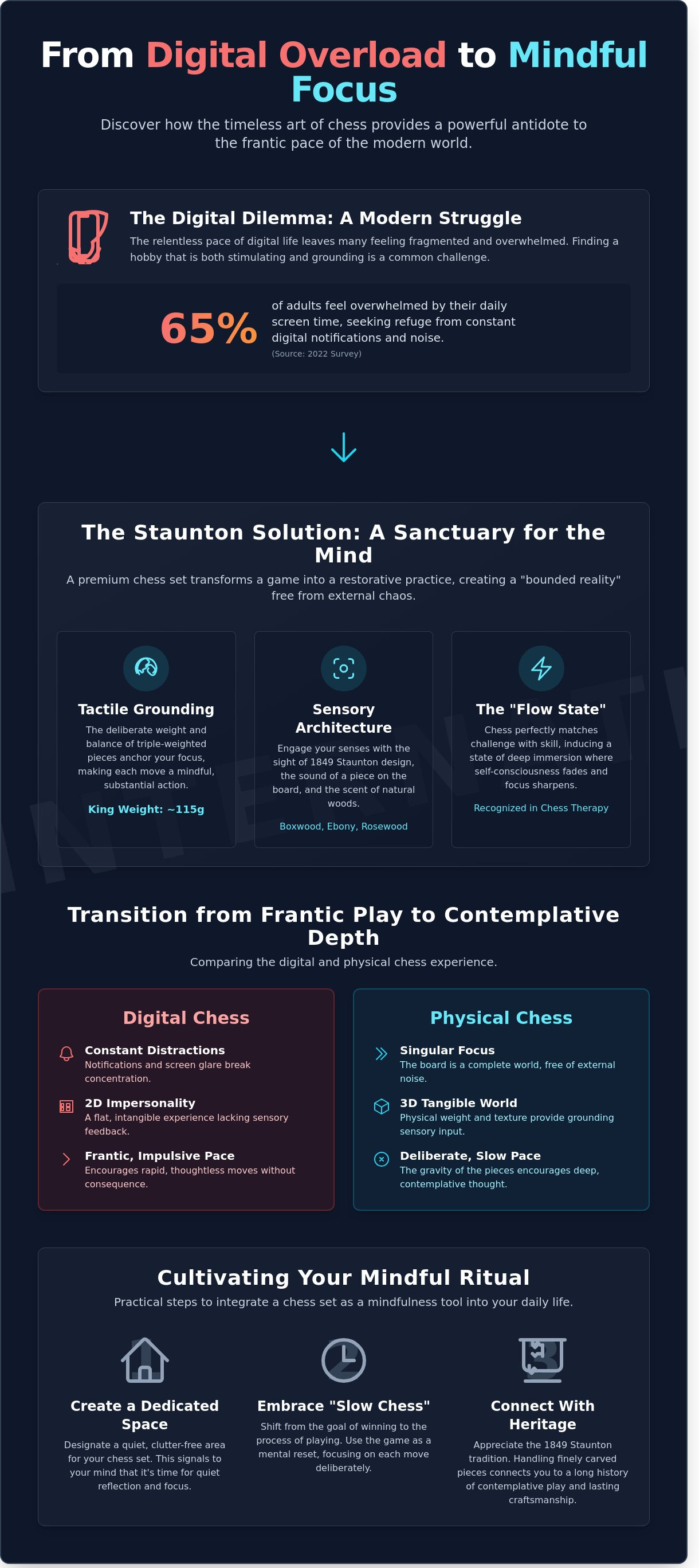
A high-quality playing set shouldn't be relegated to a dusty shelf or hidden away in a cardboard box under the bed. To truly benefit from a chess set as a mindfulness tool, you must treat the equipment with the same reverence a musician shows their instrument. This begins with finding a permanent home for your board. By designating a specific table or alcove for play, you signal to your brain that this space is reserved for deep focus and intellectual respite. When the pieces remain displayed, they serve as a constant invitation to step away from the digital world and engage with something tactile and timeless.
The environment plays a vital role in this mental transition. Soft, directional lighting that catches the carved details of the knights or the deep lustre of the dark squares creates an inviting atmosphere. You might find that a quiet room with minimal electronic distractions allows for a more profound connection to the game. Many collectors prefer warm 2700K lighting to highlight the natural grain of the timber, as this mimics the library settings of the Victorian era where the Staunton design first gained its prestige.
Treating a fine wooden chess board as a permanent fixture in your home elevates it from a simple game to a masterpiece of functional art. The act of setting up the pieces serves as a meditative gateway. As you place each of the 32 figures, focus on their specific weight; a triple-weighted king often weighs around 75 grams, providing a satisfying heft that grounds your movements. Selecting the right chess accessories, such as a hand-stitched leather storage coffer or a traditional analogue clock, further enhances the sensory experience and reinforces the ritualistic nature of the practice.
Solitary study offers a unique path to tranquility. You can use historical matches, perhaps a classic encounter from the mid-19th century, as a form of guided meditation for the mind. By physically moving the pieces through a grandmaster's masterpiece, you inhabit their thought process and rhythm. This practice provides a rare opportunity for "thinking time" away from professional burdens, allowing you to solve complex puzzles at your own pace without the pressure of a ticking clock.
Between each move, try to incorporate a simple breathing exercise. Inhale as you survey the board; exhale as you commit to a placement. This physical anchoring prevents the mind from rushing into impulsive decisions. Once the session ends, spend five minutes reflecting on your choices. Recording these thoughts in a notebook creates a form of intellectual journaling, turning each game into a record of your mental state and clarity. You'll likely find that the insights gained over the board start to bleed into your daily life, improving your patience and perspective.
Discover the perfect foundation for your mindful practice by exploring our exquisite reproduction Staunton chessmen.
A mindfulness practice requires a certain level of permanence to truly take root in one's daily life. If you use a flimsy, mass-produced plastic board, your brain often treats the session as a disposable activity rather than a sacred ritual. By choosing an heirloom-quality board and pieces, you anchor your intention in something tangible that will outlast the distractions of the day. This commitment to quality reflects a commitment to yourself. When you invest in artisan-made equipment, you're not just buying a game; you're establishing a physical sanctuary for your thoughts.
Official Staunton believes that the equipment should command respect through its weight and texture. Our Staunton reproduction chessmen are crafted to be more than just game pieces; they are instruments of focus. The heavy, triple-weighted feel of a boxwood Knight or an ebony Rook provides an immediate sensory grounding that lighter sets lack. This tactile feedback is essential when using a chess set as a mindfulness tool, as the physical sensation of the wood pulls a wandering mind back to the present moment. There is a profound ethical value in supporting the artisans who keep these traditional carving techniques alive, ensuring that your path to clarity is paved with integrity.
The 1849 design created by Nathaniel Cook and popularized by John Jaques isn't merely a style choice. It is a standard that has governed the intellectual landscape of the game for 175 years. When you play with antique reproduction sets, you're engaging with a historical lineage that transcends the individual. This historical weight creates a sense of continuity that many find deeply comforting during meditation. Official Staunton remains a dedicated custodian of this legacy, ensuring that the "soul" of the original pattern remains intact through meticulous hand-carving and traditional polishing methods. Playing with these designs offers a grounding power, connecting your modern pursuit of peace with the quiet contemplations of players from centuries past.
Every individual has a different path to mental clarity, and the materials you surround yourself with should reflect that journey. You might find that the deep, dark grain of genuine Ebony provides a somber, meditative atmosphere that aids deep concentration. Others may prefer the rich, warm hues of Rosewood or the classic, honey-toned appearance of Boxwood to create a more inviting mental space. The grain patterns in these natural materials ensure that no two sets are identical, making your tool for mindfulness as unique as your own perspective.
Choosing the right wood type and series is a personal process that shouldn't be rushed. If you're unsure which material or weight resonates best with your personal practice, our contact team is available to offer expert guidance on selection. They understand that for a connoisseur, the feel of a felted base against a mahogany board is just as important as the game itself. Ultimately, a high-quality chess set as a mindfulness tool becomes a lifelong companion. It serves as a bridge between generations and a constant, silent symbol of your pursuit of clarity in an often chaotic world.
Transforming your home into a sanctuary for focus starts with the deliberate choice of your equipment. When you engage with a chess set as a mindfulness tool, you're doing more than just moving pieces; you're grounding yourself in the tactile reality of hand-carved boxwood and ebony. This practice demands a slower pace that naturally counters the frantic noise of modern life. It's about the sensory connection between the player and the material.
Since 1993, Official Staunton has served as the dedicated custodian of the original 1849 design legacy. This ensures that every knight and rook carries the weight of history and the precision of master artisans who work with premium sustainable timbers. We provide international shipping to ensure these heirlooms reach connoisseurs of the Royal Game across the globe. You'll find that the physical weight of a triple-weighted piece provides a necessary anchor for your thoughts during a long game.
Explore our collection of handcrafted Staunton pieces to begin your journey into mindful play.
There's a unique clarity that comes from sitting before a board that commands respect. Take your time to find the presence you deserve.
Engaging with a chess set as a mindfulness tool acts as a form of active meditation, where the mind finds a singular point of focus within the 64 squares. Unlike passive meditation, this practice requires a quiet, sustained attention that anchors you in the present moment. A 2006 study by researchers at the University of Konstanz observed that expert players often enter a state of deep concentration that mirrors the brainwave patterns seen in traditional meditative practices.
While any board allows for play, the tactile nature of a premium set significantly enhances the sensory grounding required for true mindfulness. The substantial weight of a triple-weighted Staunton knight or the cool, polished surface of an ebony piece provides a physical connection that plastic alternatives lack. You'll find that the deliberate act of moving a hand-carved artisan piece encourages a slower, more intentional pace of thought.
A meaningful session typically spans between 20 and 45 minutes to allow the mind to settle into a state of flow. This duration aligns with psychological research into human attention spans, which suggests that concentration often peaks around the 20-minute mark. You might find that setting aside this dedicated window each evening creates a ritualistic space for mental restoration and clarity.
Beginners are often better positioned to use the game for mindfulness because the novelty of the rules demands total cognitive presence. Without the reliance on established patterns, a novice must examine every move with meticulous care, which naturally prevents the mind from wandering to external stressors. A 2019 report in the International Journal of Environmental Research and Public Health noted that learning new, complex tasks is a highly effective way to reduce cortisol levels.
A physical playing set eliminates the digital interruptions and blue light that frequently shatter our concentration in the modern era. Using a tangible board fosters what psychologists call "embodied cognition," where the physical interaction with the pieces helps solidify your mental strategy. By stepping away from the screen, you're avoiding the "continuous partial attention" phenomenon identified by Linda Stone in 1998, allowing for a deeper level of intellectual immersion.
The choice of timber is vital for creating a sensory sanctuary, with Boxwood and Indian Rosewood being particularly favoured for their distinctive textures. Indian Rosewood, known scientifically as Dalbergia sissoo, offers a subtle, earthy fragrance and a dense grain that feels remarkably substantial in the hand. These natural materials provide an organic warmth that connects the player to the heritage of the craft, making each move a more resonant experience.
Using a chess set as a mindfulness tool trains the brain to respond to challenges with calm, calculated logic rather than emotional reactivity. This mental discipline carries over into daily life, helping you navigate complex professional or personal situations with the same poise you maintain at the board. The game serves as a safe environment to practice staying present under pressure, which is a core tenet of stress management.
Solitaire play is perhaps one of the most profound ways to experience the meditative qualities of the game. By meticulously analysing a historical match from the 1849 era or solving complex puzzles, you engage in a private dialogue with the masters of the past. This solitary practice allows you to set your own rhythm, turning a simple study of tactics into a deeply personal and reflective mental retreat.
