
The true value of a chess set isn't found in its price tag alone, but in the silent authority it commands when placed upon a mahogany board. You perhaps know the hollow feeling of a luxury set that, despite its marketing, lacks the substantive heft and meticulous finishing required for a truly immersive game. It's a delicate challenge to find a set that honours the 1849 originals without feeling like a mere caricature of the Victorian era.
By choosing The Collector Series Chess Pieces, you're investing in a legacy that Official Staunton has preserved with uncompromising reverence for historical proportions. This guide will reveal how these pieces achieve the pinnacle of historical reproduction, ensuring you possess a set that serves as both a formidable tactical tool and a curated work of art for your library.
We'll navigate the technical specifics of King heights and base diameters to ensure your new set fits your board perfectly; a detail that, if overlooked, can disrupt the visual harmony of the entire game. You'll gain the confidence to identify authentic 1849 design features and understand why the tactile satisfaction of a 2,000-gram, triple-weighted set fundamentally changes the way you experience each move.
When we look at the evolution of the game, few moments are as pivotal as the release of the original Staunton pattern on 29 September 1849. Before this date, players struggled with a chaotic variety of sets, such as the spindly Selenus or the overly ornate Regency, which often tipped over or confused the eye during intense play. The introduction of the 1849 design changed everything by offering a silhouette that was both elegant and practically indestructible. You can explore the full Staunton chess set history to see how this transition defined the modern era of competitive play.
To see the physical stature and the various wood finishes of these sets in motion, watch this detailed overview:
The Collector Series Chess Pieces represent our commitment to preserving this specific 19th-century aesthetic. While many modern sets simplify the carving to save time, this series retains the old-world gravitas that made the original Jaques sets so coveted by the Victorian elite. It isn't just about the shape; it's about the weight and the way the broader bases anchor each piece to the board, providing a tactile reassurance during a match.
Nathaniel Cook’s design, famously endorsed by the champion Howard Staunton, was a masterclass in Victorian functionalism. By standardising the symbols, like the mitred bishop and the crenellated rook, he created a universal language for players. The Collector Series meticulously recreates these period-correct features, particularly the "Cook" style knight with its low-headed, fierce expression. This attention to detail ensures that the set feels less like a modern replica and more like a recovered heirloom from a 19th-century London club.
Another factor worth considering is how The Collector Series Chess Pieces differ from entry-level or even other historical variants. These pieces typically feature a 4.4-inch king with a base diameter of approximately 50mm, offering a much more robust profile than the slender "Morphy" sets of the 1850s. While the "Fischer-Spassky" sets focus on the stark utility required for 20th-century tournaments, the Collector series celebrates the artisan's chisel. This leads to an interesting point; the broader bases and triple-weighting don't just improve stability, they transform the rhythmic "thud" of a move into a statement of intent. Handling a piece carved from genuine ebony or boxwood creates a visceral connection to the heritage of the game that plastic or mass-produced wood sets simply cannot replicate.
To hold a piece from The Collector Series Chess Pieces is to feel the weight of nearly two centuries of design evolution resting in your palm. The choice of timber is the first indicator of a set's pedigree, and for the serious connoisseur, Genuine Ebony and Natural Boxwood remain the quintessential pairing. Ebony is prized for its immense density and its ability to take a high polish, resulting in a deep, obsidian finish that feels cool and substantial to the touch. When paired with the warm, buttery tones of Boxwood, the visual contrast creates a clarity on the board that is essential for deep calculation during a match.
The sensory experience of a hand carved chess set goes far beyond its appearance. There is a specific tactile feedback found in the Collector Series that mass-produced sets simply cannot replicate. Much of this comes down to the triple-weighting process. By incorporating a lead core into the base of each piece, artisans lower the centre of gravity, ensuring that every move concludes with an authoritative thud. This stability is complemented by the application of thick billiard cloth felting. This high-grade felt allows the pieces to glide effortlessly across wooden chess boards, protecting the delicate grain of the surface while providing a cushioned landing for every capture.
While Genuine Ebony offers a profound, regal depth that mirrors the 1849 Jaques Staunton set found in the Victoria and Albert Museum, many collectors find themselves drawn to the variegated grains of Blood Rosewood. Unlike the uniform darkness of Ebony, Rosewood features rich, reddish-brown streaks that seem to glow under soft library lighting. It is a wood that ages gracefully; over twenty or thirty years of regular play, the timber absorbs natural oils from the hands, developing a unique patina that tells the story of every game played. Choosing between them is rarely about quality and more about the specific "feel" you wish to cultivate in your study.
The Knight is widely regarded as the soul of any The Collector Series Chess Pieces set because it is the only piece that defies the geometric abstraction of the others. It requires a master carver to translate the ferocious expression and distinct musculature of the 1849 heritage into a small block of wood. Achieving perfect symmetry in hand-carved boxwood is a Herculean task. I have often observed that even the most skilled artisans will spend more time on the four Knights than on the rest of the set combined. This human element means that each Knight carries a slight, individual signature, a subtle reminder that your set was shaped by a person rather than a machine. If you are looking to begin your own journey into high-level collecting, you might browse our heritage collections to see these carvings in greater detail.
Choosing the right dimensions for a chess set is about more than just desk space; it's about the psychological weight of the game itself. The Collector Series Chess Pieces are offered in three distinct heights: the 3.75-inch, the 4.0-inch, and the commanding 4.4-inch King. Each size dictates a different relationship with the board. A base that's too wide for its square creates a sense of claustrophobia, obscuring the diagonal lines that are vital for spotting a long-range Bishop sacrifice. Conversely, a set that's too small feels insubstantial, lacking the gravitas required for serious study or display.
A detail often missed by casual players is the inclusion of four Queens as a standard across the entire range. This isn't merely a convenience; it's a nod to the modern tournament standard, ensuring that your set remains a masterpiece of functional art even during the most complex endgames where a pawn promotion is imminent.
Official Staunton considers the 4.0-inch King the pinnacle of balance, which is why it remains the most sought-after choice for luxury chess sets. This specific height offers a substantial presence on the board without becoming cumbersome during the frantic time scrambles of a blitz game. Why does this height feel so right? It's largely due to the weighting. These pieces are typically triple-weighted, bringing the total set weight to approximately 1.8kg. This heft ensures that even a light brush of the hand won't tip a piece, maintaining the integrity of the position. We've found that this size adheres most closely to the "Golden Ratio" of chess aesthetics, where the King's base occupies roughly 78% of the square's width on a standard board.
There are moments when a game demands a more theatrical stage. The 4.4-inch version of The Collector Series Chess Pieces is designed for the grand library or the dedicated study. It's a statement piece, plain and simple. Because of the expansive base diameters, you'll need a board with squares of at least 60mm to avoid a cluttered battlefield. These sets often exceed 2.2kg in total weight, providing a tactile experience that feels almost architectural. Every move feels deliberate when you're lifting a piece of such physical gravity.
Another factor worth considering is the visual impact of the taller pieces. In the 4.4-inch set, the intricate carving of the Knight’s mane and the delicate crown of the Queen are more pronounced, allowing the artisan's skill to be appreciated from across the room. It’s less about portable play and more about creating a permanent installation of intellectual prestige.
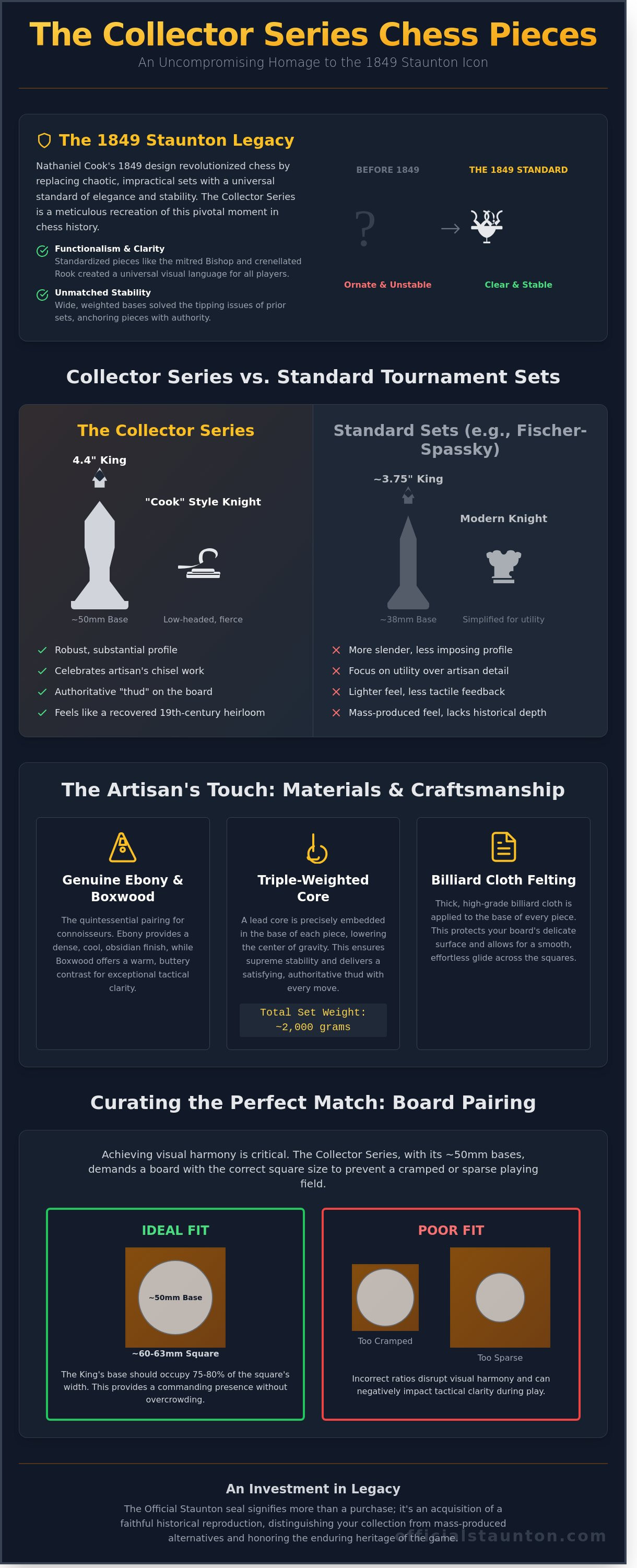
Selecting the right battlefield for your chessmen is a task that requires both an eye for geometry and an appreciation for material harmony. The fundamental rule of thumb among serious players is to ensure the King’s base occupies between 75% and 80% of the square size. If the square is too narrow, the pieces feel crowded and the board becomes difficult to read during complex middle-game transitions. Conversely, squares that are too large make the pieces look adrift, breaking the visual connection between the squares that is so vital for calculation.
For a set with the presence of The Collector Series Chess Pieces, the choice of finish is just as critical as the size. While high-gloss boards often look spectacular in a display cabinet, they're frequently a hindrance during actual play. Glare from overhead lighting can bounce off a polished surface, causing eye strain and obscuring the position of the pieces. A matt or satin finish is almost always superior for serious analysis, as it absorbs light and allows the natural grain of the timber to provide a soft, focused backdrop for your moves.
Another factor worth considering is the physical height of the board and how it affects your seated posture. A board that sits too high off the table can lead to shoulder fatigue during a long match, as it forces your arms into an unnaturally elevated position. A slimmer, lower-profile board often provides a more ergonomic experience, keeping your focus entirely on the 64 squares rather than physical discomfort. It's these small, practical details that separate a casual setup from a professional's study.
The classic contrast of Ebony and Boxwood pieces is traditionally showcased on a Maple and Walnut board. The deep brown of the Walnut offers a warmth that bridges the gap between the stark black Ebony and the pale Boxwood. For a more contemporary aesthetic, pairing The Collector Series Chess Pieces with an Ebony and Maple board creates a monochromatic masterpiece that feels both sharp and sophisticated. You should also think about the tactile harmony between the felted base and the board surface; a high-quality hardwood board provides a satisfying, muted thud when a piece is placed firmly on a square.
A set of this pedigree deserves more than being left to gather dust on a shelf. A fitted chess box is essential to prevent the "clashing" of pieces, which can lead to minute chips or "flea bites" on the delicate carvings. Beyond physical impacts, you must manage the environment; boxwood is a living material that reacts to its surroundings. Maintaining a stable humidity level, ideally between 45% and 55%, helps prevent the wood from developing "checks" or hairline cracks over time. A simple ritual of wiping each piece with a soft, dry cloth after a game will preserve the artisan’s polish and keep the set in pristine condition for decades.
The Official Staunton seal of approval represents a solemn commitment to the historical integrity of the staunton chess set. Choosing a set from The Collector Series Chess Pieces isn't merely a purchase; it's an acquisition of a functional antique that carries the weight of 19th-century intellectual history. While mass-produced sets often rely on chemical stains to mimic premium timbers, our artisans work with the natural density of the wood itself, ensuring that the weight and balance feel as substantial in your hand as they did for players in 1849.
The long-term value of a handcrafted set remains far superior to its factory-line counterparts. A set turned from genuine ebony or African padauk develops a rich patina over decades, increasing in character and desirability. We understand that life happens, which is why our dedicated restoration services are vital for any serious investor. If a knight's ear is damaged or a pawn goes missing twenty years from now, our craftsmen can match the grain and carving of your specific edition, ensuring your heirloom remains complete for the next generation. It's this level of stewardship that separates a temporary toy from a lifelong companion.
Our quality control process is famously rigorous, focusing on a 12-point inspection for every piece. We ensure that The Collector Series Chess Pieces maintain a strict weight consistency, often triple-weighting the bases with lead to provide that satisfying "thud" on the board. We source only ethically harvested Grade-A timbers, such as genuine ebony that has been seasoned for at least three years to prevent cracking. This bridge between Victorian artistry and modern durability ensures that while the design is 175 years old, the structural integrity is built for the 21st century.
Before making your final selection, consider the tactile harmony between the pieces and your playing surface. A 4-inch King typically requires a board with 55mm or 60mm squares to avoid a crowded aesthetic. Think about the wood tones; do you prefer the stark, regal contrast of Ebony or the warm, traditional hues of Boxwood and Rosewood? There is a profound emotional reward when you first lift a piece of this calibre. We invite you to explore our full collection or speak with our resident experts to find the specific set that resonates with your personal style.
Owning a fine chess set fundamentally changes how you approach the game. When you sit down before a set of this quality, the distractions of the modern world seem to fade, replaced by a quiet reverence for the task at hand. The cool touch of the polished wood and the intricate detail of a hand-carved knight transform a simple match into a deep, meditative experience. It's a reminder that some things in life are still worth doing slowly, with precision and a deep respect for the traditions that came before us.
Owning a set from this collection isn't just about acquiring game pieces; it's about becoming a guardian of a design that has defined the game for nearly two centuries. Since 1993, our master artisans have dedicated themselves to reviving the exact 1849 Staunton proportions, ensuring that every knight's mane and every king's finial reflects the original Victorian vision. When you hold one of The Collector Series Chess Pieces, the weight and balance reveal a level of meticulous hand-carving that modern mass production simply cannot replicate.
Selecting the perfect set involves more than just aesthetics; it's about finding the right proportions to suit your study or drawing room. We take immense pride in our heritage, which is why every order is dispatched with worldwide shipping in protective packaging designed to safeguard these functional works of art. It's a rare opportunity to invest in a legacy that will be passed down through generations, maintaining its beauty and historical relevance long after the final checkmate is called.
Explore the Full Collector Series Collection at Official Staunton
The primary distinction lies in the historical timeline, as The Collector Series Chess Pieces recreate the original 1849 design whereas the Morphy Series reflects the slightly later 1851 evolution. You'll notice the Collector set features a more robust, "fat-base" silhouette that characterises the earliest Staunton patterns. The Morphy variant introduces subtle refinements to the knight's mane and the crown on the kingside rook, catering to those who prefer the mid-Victorian aesthetic over the debutante 1849 style.
Every piece in this series is triple-weighted with lead to ensure they meet the rigorous demands of professional tournament play and home study alike. This added mass provides a satisfying "thud" on the board, preventing accidental tip-overs during a frantic blitz game or a thoughtful grandmaster session. We use high-quality green billiard cloth on the bases, which allows the pieces to glide effortlessly across the wood without leaving a single scratch or mark.
A 4.0-inch King requires a board with square sizes between 55mm and 60mm to maintain the correct visual proportions and prevent the ranks from feeling cluttered. If you choose a square smaller than 55mm, the broad bases of these pieces won't have enough "breathing room," which can distract you during complex tactical calculations. We often recommend a 58mm square for this specific set, as it provides the perfect balance between the piece's footprint and the surrounding mahogany or walnut.
We include two additional Queens with every set in the series to accommodate pawn promotion without the need for makeshift substitutes. It's a standard we've maintained since our inception, ensuring that your endgame remains as elegant as your opening. There's something quite disheartening about turning a captured rook upside down when you've successfully navigated a pawn to the eighth rank, so providing four Queens in total preserves the dignity of your game.
You should maintain your Ebony and Boxwood pieces by buffing them gently with a dry, lint-free microfibre cloth every few weeks to remove natural oils from your skin. For a deeper clean, a tiny amount of high-quality Renaissance Wax can be applied once a year to preserve the wood's lustre and prevent it from drying out. Avoid using any liquid cleaners or damp cloths, as moisture can cause the fine grain of the Boxwood to swell or the Ebony to develop hairline fractures over time.
The Collector Series Chess Pieces are perfectly suited for use on a premium leather board, provided the leather is taut and professionally mounted. The weighted bases and fine felt ensure the pieces sit firmly on the textured surface, offering a unique tactile experience that differs from traditional wooden boards. Many players enjoy the muffled sound of a piece landing on leather, though you should ensure the board's squares are at least 55mm to accommodate the set's generous proportions.
The Knight in this collection is a meticulous tribute to the 1849 Cook design, which was famously inspired by the horse carvings on the Elgin Marbles. Unlike generic modern knights, this piece features a distinctively low-slung head and a detailed mane that requires hours of hand-carving by a master artisan. It captures the raw energy of the Parthenon sculptures, making it a focal point for any collector who appreciates the intersection of classical art and competitive sport.
This set is a remarkably faithful reproduction that captures the exact dimensions, weight, and "fat-base" geometry of the original 1849 Jaques sets. We've spent years studying archival examples to ensure every curve of the Bishop's mitre and every crenulation on the Rook's tower matches the Victorian blueprints. It isn't just a tribute; it's a piece of living history that allows you to experience the same tactile weight that players like Howard Staunton himself would have felt.
