
A chess set is rarely just a game; it's a silent testament to a player's respect for a tradition that dates back to the pivotal 1849 design. You likely understand that the specific weight of a hand-carved knight or the precise bevel of a triple-weighted base can transform a casual match into a profound intellectual ritual. It's this appreciation for historical accuracy that drives the selection of our best selling products at Official Staunton, as discerning collectors look toward 2026 for pieces that serve as both functional art and legacy investments.
Selecting the right equipment often feels daunting when you're faced with countless low-quality imitations that lack the balance and authority of a genuine Staunton pattern. We'll show you exactly why certain heritage designs remain the most coveted in the chess world and how to pair specific piece heights, such as a 95mm king, with a 55mm square board to ensure a professional aesthetic. This guide provides the clarity needed to recognise the subtle markers of artisan carving that separate a mere toy from a true masterpiece of play.
Selecting a luxury chess set is an exercise in discerning the subtle interplay between historical fidelity and the physical sensation of polished hardwood. It's a journey that takes the enthusiast beyond the shelves of mass-produced goods into a world where every knight's mane is carved by a steady, experienced hand. For the serious player, the appeal of our best selling products isn't found in fleeting trends; it's rooted in a consensus that has spanned nearly two centuries within the global chess community.
The 1849 Staunton pattern remains the undisputed gold standard for both competitive play and private collections. It represents a specific moment in 1849 when aesthetics and utility met in perfect harmony, creating a silhouette that's immediately recognisable yet infinitely refined. You aren't merely buying a tool for play; you're acquiring a family heirloom that's designed to withstand the rigours of intense study while maintaining its quiet grace on a mahogany library table. This balance of tactile luxury and historical accuracy is what separates a true masterpiece from a mere consumer good.
Collectors often gravitate towards designs that carry a documented lineage because there's a profound emotional weight in grasping a king that mirrors the exact dimensions used by Howard Staunton himself. This connection to the past transforms a simple game into a historical dialogue, allowing the modern player to feel the same weight and balance as the mid-century grandmasters. Our most popular selections have remained at the pinnacle of the community's preference for decades because they offer this sense of intellectual prestige. They aren't just objects; they're vessels for the game's rich heritage and the stories of those who played before us.
True quality is found in the minute details that a machine simply cannot replicate. A genuine artisan-crafted set reveals itself in the sharp, crisp lines of the queen's coronet and the expressive, individual character of each hand-carved knight. While many "best selling" lists are often cluttered with generic alternatives, the true connoisseur looks for faithful reproductions of antique chess sets that respect the original Victorian specifications. These sets maintain their value precisely because they refuse to compromise on the traditional methods of fine woodworking.
Verified provenance is essential when you're investing in a high-end acquisition. It's the difference between a set that loses its charm after a few years and one that develops a rich, deep patina over several generations. You might wonder if these small details truly matter during the heat of a match. In practice, the perfect balance of a triple-weighted piece and the soft, dampened thud of a felted base against a wooden board provide a tactile feedback that enhances the entire strategic experience. It's this commitment to the sensory side of the game that defines our most sought-after collections as we look toward 2026.
A chess piece represents more than a tool for strategy; it serves as a tactile connection to centuries of craftsmanship. When you lift a piece from our collection, the first thing you'll notice is the deliberate choice of timber. We select genuine Ebony for its incredible density, which often exceeds 1,200 kg/m3, giving the dark pieces a cold, stone-like presence in the hand. This contrasts beautifully with the Boxwood pieces, which offer a natural warmth and a fine grain that develops a deep, honey-coloured patina over decades of regular play.
The choice of material isn't merely about visual appeal. It's about the sensory feedback during a match. The weight of the timber, combined with the smoothness of the grain, informs how a player interacts with the board. You might find that the heavier Ebony pieces encourage a more deliberate, thoughtful style of play, while the lighter Boxwood allows for a more fluid movement during time-pressured endgames.
There's a specific confidence that comes from a piece that refuses to topple. Triple-weighting involves the precise insertion of lead into the base of each piece, a process that moves the centre of gravity much lower than standard sets. This creates the iconic "thud" that resonates through the board during a decisive move. Our Morphy Series Chess Pieces are a masterclass in this balance, providing a physical gravity that matches the intellectual weight of a grandmaster's game.
This added mass serves a practical purpose beyond the auditory satisfaction of a firm move. In a competitive setting, a weighted piece stays exactly where it's placed, even if the board is accidentally nudged. This stability allows the player to focus entirely on the position rather than the physical fragility of the equipment.
You might wonder why the Knight often dictates the price and prestige of a premium set. It's because this is the only piece that cannot be turned entirely on a lathe; the head must be carved by hand by a master artisan. In our best selling products, the Knights possess individual personalities, with flared nostrils and focused eyes that no CNC machine could ever replicate. These subtle variations are the hallmarks of a human touch, ensuring that every set carries its own unique soul.
The difference between a mass-produced Knight and a hand-carved one is immediately apparent to the trained eye. A hand-finished piece has sharp, crisp lines and intricate detail in the mane that reflects the carver's specific style. This level of detail is why our best selling products are often treated as investments rather than mere toys. The artistry involved in creating a uniform set of four Knights, all matching yet individually carved, is a feat of coordination that few workshops can achieve.
The final stage of creation involves a meticulous hand-polishing process using natural waxes rather than thick, artificial lacquers. This isn't just to make the wood shine. The oils penetrate the grain to protect the timber from humidity and the natural oils of a player's hands. It's this level of care that ensures these pieces remain heirloom quality for generations. If you're looking for a set that embodies this standard, you might enjoy exploring our range of hand-finished chessmen.
Selecting a fine chess set is rarely a matter of simple utility; it's an exploration of history and a commitment to the aesthetic of the game. Our best selling products for 2026 are defined by this connection to the past, offering players a tangible link to the masters who defined the sport. Whether you're drawn to the Victorian opulence of the Morphy Series or the stark, functional beauty of the Fischer Spassky 1972, each set serves as a testament to the artisan's skill and the enduring legacy of the Staunton design.
The Morphy Series remains the pinnacle of our collection for those who appreciate the robust proportions of the mid-19th century. These staunton reproduction chessmen draw direct inspiration from the sets used during Paul Morphy's legendary tenure in the 1850s. You'll notice the pieces possess a lower centre of gravity and broader bases than many modern alternatives, providing a reassuring stability during intense play. The knight, often the most scrutinised piece in any set, features a traditional, stoic expression that reflects the quiet confidence of the Victorian era, making it a favourite for those who value classical elegance.
While the Morphy Series celebrates elegance, the Fischer Spassky 1972 series is built for the serious student. Known widely as the Reykjavik design, this set stripped away the ornate flourishes of earlier centuries to focus on pure, minimalist functionality. It became the global standard for tournament play after the 1972 World Championship, and its popularity hasn't waned in over 50 years. The pieces are designed to be gripped easily and moved swiftly, making them ideal for modern blitz or rapid-play formats where every second counts. This set isn't just a piece of history; it's a practical tool for the modern competitor.
For those just beginning to curate a high-end collection, the Collector Series offers an approachable entry point. It maintains the rigorous standards of Official Staunton while providing a design that is versatile enough for both daily study and permanent display. This series often serves as the foundation for a lifetime of collecting, offering the same triple-weighted balance found in our more expensive historical recreations. It's a sensible choice for the enthusiast who wants professional-grade equipment without the price tag of a rare limited edition.
The enduring appeal of these best selling products often comes down to the price-to-value ratio of hand-carved boxwood. While exotic timbers like ebony or rosewood are prized for their rarity, boxwood provides a density and fine grain that allows for incredible detail. An artisan may spend upwards of 25 hours carving a single set of knights, a level of dedication that ensures your investment will endure for generations. You might find that the tactile sensation of polished boxwood, combined with its natural resilience, makes it the most practical choice for a set that's meant to be used daily rather than merely observed from behind glass.
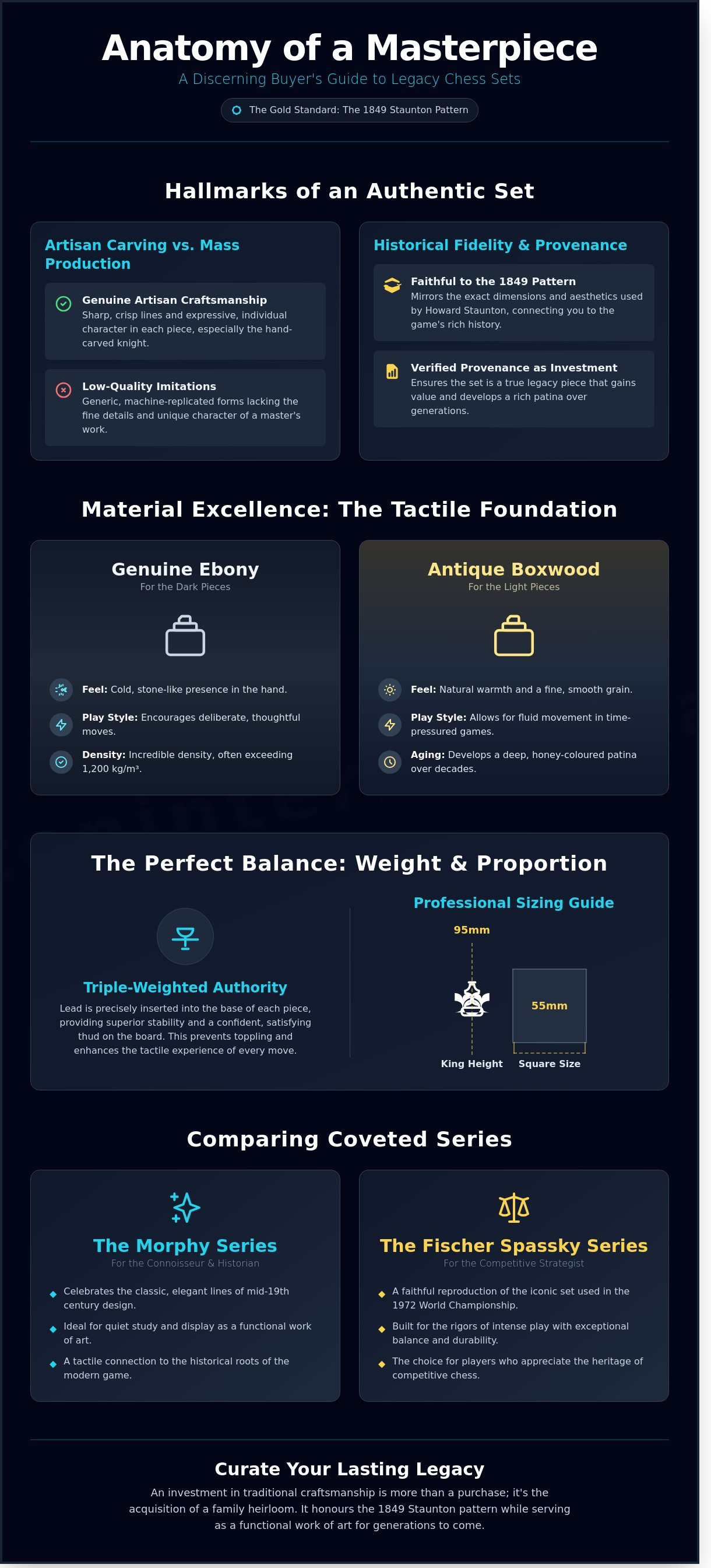
Acquiring a world-class chess set is a ritual that demands both technical precision and an appreciation for heritage. It's a process that begins with a clear understanding of the set's intended life. You should first determine if the pieces will endure the rigours of daily study and 2026 tournament play, or if they're destined to remain a stationary masterpiece in a private library. A set designed for active play requires the durability of dense hardwoods like Boxwood and Ebony, whereas a display piece might prioritise the intricate, fragile carving of a Knight’s mane over sheer portability.
Proportions are the next logical consideration for any serious collector. A King standing 3.75 inches tall, which is the standard for professional play, typically features a base diameter of approximately 1.7 inches. To ensure the board doesn't feel suffocated, this base should occupy between 75% and 78% of the individual square's width. Matching the timber is equally vital for aesthetic harmony. You might choose to pair deep Ebony pieces with a wooden chess board crafted from Walnut or Macassar to ensure the grain patterns complement rather than compete. Finally, consider the storage environment. High-quality wood finishes are organic materials that breathe, so a felt-lined casket is essential to protect the polished surface from humidity shifts and dust.
Many collectors make the mistake of choosing a board that's too small for their pieces. This creates a crowded game where the tactical geometry of the 1849 design is lost. Another frequently overlooked detail is the quality of the felted base. Official Staunton utilises premium billiard cloth because thin, synthetic felts often trap grit that can scratch a fine board over time. If you've selected a set with an antiqued patina, avoid modern chemical polishes. These historic finishes are best maintained with a simple, dry microfibre cloth to preserve their unique character.
Visual synergy is what separates a mere assembly of equipment from a true collection. Ebony pieces find their natural home on boards featuring Ebony or dark Walnut, creating a seamless and executive aesthetic. You can also use contrast to your advantage during play. Selecting a board with high-contrast Sycamore or Maple squares makes the dark pieces stand out more clearly during time-pressured matches. You'll find several curated pairings among our best selling products that have been meticulously tested for both visual clarity and historical accuracy.
Discover the pairings that have defined our collection this year by exploring the full range of best selling products available today.
Choosing a set from our most popular designs isn't just about acquiring a game; it's an investment in a tradition that has defined the aesthetic of chess for 177 years. Since the original Staunton pattern was first registered in 1849, it has stood as the definitive standard for competitive and casual play alike. Official Staunton remains the premier destination for those who refuse to compromise on quality because we view ourselves as custodians of this legacy. We don't simply provide equipment; we offer pieces of functional art that carry the weight of history in every hand-carved knight.
Owning such a set involves a commitment to its preservation over several decades. Wood is a living material that reacts to its environment, and even the most meticulously crafted ebony can require attention as the seasons pass. This is why we place such high importance on after-sales care. If your heirloom requires professional attention, our restoration services are available to ensure your investment remains in pristine condition for the next generation. We invite you to explore the full curated list of our most beloved designs to find the set that speaks to your personal style.
The Staunton pattern possesses a timeless nature that makes it entirely immune to the fast-fashion cycles of the modern toy industry. While contemporary, abstract designs often lose their appeal within a few years, a classic boxwood and ebony set retains a quiet authority. You'll find that these sets don't just hold their value; they often increase in worth as they transition into vintage pieces. A high-quality set purchased today will likely be worth significantly more by the year 2050, provided it's well-maintained. There's a profound joy in knowing that the set you use today will be the same one your grandchildren use to learn their first opening gambits.
Serious collectors understand that the longevity of their best selling products depends heavily on how they are stored when the game is over. A fitted chess box with individual slots for each piece prevents the delicate collars and crowns from chipping against one another during transport or storage. It also provides a stable micro-environment that shields the wood from sudden temperature shifts. Pairing your best selling products with a dedicated storage solution isn't an afterthought; it's the final step in creating a truly luxury chess experience. A set that is respected in its storage will invariably command more respect on the board.
Ultimately, the choice of a fine chess set is a reflection of one's appreciation for the slower, more thoughtful aspects of life. It’s about more than just the 64 squares; it’s about the tactile connection to a game that has challenged the greatest minds for centuries. When you hold a piece that has been triple-weighted and polished to perfection, you aren't just playing a game. You're participating in a story that continues to unfold with every move you make across the mahogany and maple.
Choosing a chess set isn't just about finding something to play with; it's about acquiring a piece of history that'll sit on your desk for decades. Since 1993, we've focused on handcrafting sets that respect the original 1849 Staunton design, ensuring every knight's mane and every rook's battlement feels historically accurate. You've seen how the choice of material, like deep ebony or fine boxwood, changes the tactile experience of a match. It's why international collectors have trusted us as their official suppliers for over thirty years.
Selecting from our most coveted series means you're investing in a legacy that balances aesthetic beauty with the practical weight required for serious play. Whether you're drawn to the Morphy series or the classic Fischer Spassky sets, the right choice is always the one that resonates with your personal style. We've spent years perfecting these reproductions so you can focus on the strategy of the game. Take a moment to browse our curated selection and find the set that speaks to your own sense of tradition.
Explore the Best Selling Products Collection and bring a masterpiece to your board today.
Our best selling products are defined by a rigorous assessment of historical importance, the frequency of selection by professional FIDE players, and consistent acquisition rates from global collectors. We focus on designs that have endured for over 170 years, such as the 1849 Staunton pattern, which remains our most requested silhouette due to its perfect equilibrium of form and function. It's about identifying which pieces have stood the test of time since their mid-19th-century inception.
Every set in our premier collection is engineered for the rigours of serious, competitive play. While they possess an aesthetic quality suitable for a gallery, they're triple-weighted to provide approximately 120 grams of stability for the larger pieces and hand-polished to ensure they glide smoothly across the timber. We believe that true luxury is found in the functional excellence of the equipment during a four-hour match, ensuring the weight and feel remain consistent from the opening to the endgame.
The most effective way to choose is to ensure the base of the King occupies between 75% and 80% of the individual square size on your board. For our signature 4-inch Kings, a board featuring 55mm squares is the ideal pairing to allow for necessary breathing room. This specific ratio ensures the 64 squares don't feel cluttered, providing the visual clarity required for precise tactical vision during a game. You might find that a smaller square makes the pieces feel cramped, which can hinder your concentration.
Ebony is a naturally dark, incredibly dense hardwood with a high specific gravity that provides a striking, modern luxury feel for the contemporary study. In contrast, our Antiqued Boxwood undergoes a meticulous, multi-stage staining process to replicate the deep, honeyed hues found in 19th-century museum sets. Both materials are staples among our best selling products, but the choice usually rests on whether you prefer a crisp, new aesthetic or the storied, vintage look of a heritage heirloom.
We maintain a dedicated inventory of replacement pieces for our primary series to ensure your investment remains complete for decades. This is a significant benefit of choosing a design from our permanent heritage collection; because these patterns don't change, we can provide a match for the specific carving and grain even years after your initial purchase. It's a service we provide as part of our role as custodians of the Staunton legacy, protecting your set against accidental loss.
These series remain sought after because they represent the "golden eras" of 1858 and 1972 respectively. The Morphy series captures the height of mid-Victorian elegance with its delicate carving, while the Fischer Spassky series is a precise tribute to the most famous match in the history of the game. They offer players a tangible way to connect with the legends of the board through the very tools they used to achieve greatness. You're not just buying a playing set; you're acquiring a piece of historical narrative.
