
A grandmaster's set, perhaps a meticulous 1849 reproduction in genuine ebony, is far more than a collection of gaming pieces; it's a fragile investment in history that can be ruined by a single careless tumble in a cavernous, unlined container. You've likely spent years curating a collection that reflects your passion for the game, yet the constant worry of a knight's delicate mane chipping or a bishop's mitre scratching against its neighbour remains a persistent shadow over your pride of ownership. It's a common anxiety for the serious collector who understands that even a minor blemish can diminish the value of a triple-weighted masterpiece worth hundreds of pounds.
This guide explores the necessity of Fitted Chess Boxes, explaining why these bespoke sanctuaries are the only way to ensure your boxwood and rosewood treasures remain as pristine as the day they left the artisan's lathe. We'll walk through the technical nuances of king height compatibility and the importance of individual compartments, providing you with the exact measurements needed to secure a legacy that lasts for generations. You'll gain the confidence to select materials that won't just house your pieces, but will actively protect them from the subtle dangers of wood warping and environmental shifts.
A fitted chess box represents the pinnacle of protective craft; it moves far beyond the utilitarian nature of a simple wooden container. While a standard coffer or bulk box allows pieces to jostle and collide during movement, Fitted Chess Boxes provide a dedicated sanctuary where every piece is cradled in its own felt-lined berth. This specialised design acts as a silent custodian for your collection, ensuring that the intricate carvings of a knight's mane or the delicate crenellations of a rook remain as pristine as the day they left the workshop.
To better understand the practical advantages of various storage designs, watch this helpful comparison video:
Choosing a luxury fitted sanctuary over a basic wooden box is a decision rooted in both aesthetics and long-term preservation. For the serious collector, the box is an extension of the set itself. It reflects a commitment to honouring the materials, whether that be the deep lustre of ebony or the warm grain of high-grade boxwood. By providing a structured environment, these boxes prevent the atmospheric fluctuations and physical impacts that can lead to hairline fractures in older, seasoned woods.
The physics of chess piece preservation reveals why isolation is essential. The delicate collars of pawns and the ornate crowns of kings are particularly vulnerable to impact. When pieces are stored loosely, the sheer weight of a triple-weighted set can cause significant damage during transit. By isolating each piece within a bespoke cavity, we eliminate the risk of the abrasive scuffing that often plagues ebony sets. There is also a profound psychological satisfaction in the organisation; seeing each piece in its rightful place creates a ritualistic experience when setting up for a match. It transforms the act of opening the box into a curated presentation of one's intellectual tools.
The history of chess storage has evolved significantly from the simple cloth drawstring bags used in the 18th century to the opulent Victorian mahogany coffers of the mid-1800s. When the world adopted The Official Staunton Standard in 1849, the increased detail of the pieces necessitated a more sophisticated approach to their care. Simple boxes were no longer sufficient for the high-quality carvings that defined the new era. Today, Official Staunton continues this tradition by refining these historical necessities for 2024. We ensure that modern Fitted Chess Boxes meet the exacting standards required for contemporary triple-weighted pieces while maintaining the timeless elegance that a serious library or study demands. The result is a piece of furniture that serves as a bridge between Victorian craftsmanship and modern durability.
Investing in such a specialised case ensures that the value of your set is maintained for decades. It is a practical acknowledgement that a fine chess set is not merely a game, but a heritage item that deserves to be guarded with the utmost care and reverence.
Selecting a vessel for a fine Staunton set is an exercise in discerning the subtle interplay between aesthetic grace and structural permanence. We often find that collectors focus heavily on the intricate carving of the Knights, yet the longevity of those very pieces depends entirely on the chamber in which they rest. High-end boxes typically utilise dense, sustainable timbers like Grade-A mahogany or rich walnut veneers, materials chosen not merely for their deep hues but for their natural resistance to warping. A solid wood construction, often featuring 12mm thick walls, provides the necessary mass to anchor the set, ensuring that the box feels as substantial as the history it contains.
Proper timber selection is the first line of defence against the environmental shifts that can cause fine boxwood to crack or ebony to splinter. This level of care mirrors the techniques used by professional curators for Preserving a Grandmaster’s Legacy, where maintaining stable humidity and temperature is paramount for organic materials. When a box is constructed with traditional dovetail joints, it becomes more than a container; it becomes an heirloom capable of surviving a century of seasonal changes without the corners pulling apart. These interlocking joints provide a mechanical strength that modern screws or simple glues cannot replicate.
There is a particular, almost musical satisfaction in the operation of a well-balanced lid. As you lift it, the weight should feel deliberate, offering just enough resistance to suggest quality without being cumbersome. The soft thud of the lid meeting the base is a signature of precision engineering, a sound that signals the end of a session and the safe return of the warriors to their barracks. It is a tactile reminder that the game of chess is as much about the physical ritual as it is about the mental struggle.
Within the interior, the choice of material serves as the final embrace for each piece. While many modern alternatives exist, the historical preference for green baize remains steadfast among purists. This wool-based fabric is exceptionally durable and possesses natural moisture-regulating properties that synthetic velvets lack. For those seeking the ultimate in protection, Fitted Chess Boxes featuring individual compartments or high-density foam inserts prevent the pieces from colliding during transport. It is vital to ensure that any artisan crafting these interiors uses pH-neutral, non-acidic adhesives. Standard glues can off-gas over several years, leading to the unfortunate tarnishing of fine lacquers or the degradation of the wood’s natural oils.
The mechanical integrity of the box rests upon its hinges. We find that quadrant hinges are vastly superior to standard butt hinges because they incorporate a built-in stay, allowing the lid to remain open at a precise 90-degree angle. This prevents the lid from falling backwards and straining the wood grain at the rear of the box. Solid brass is our preferred medium for all fittings, including the lock and key sets that guard a collection from accidental spills or inquisitive hands. Unlike plated steel, which may flake or corrode within a decade, solid brass develops a gentle patina that complements the ageing process of the timber. You might explore our range of hand-polished storage solutions to see how these elements harmonise in practice.
This attention to the internal architecture ensures that the box does not merely store the pieces, but actively contributes to their preservation for the next generation of players.
Choosing a sanctuary for a premium chess set requires an understanding of the physical forces at play when these objects are at rest. The traditional wooden coffer, often featuring a simple slide-top or a hinged lid with a green felt lining, has served players since the mid-19th century. These vessels are remarkably efficient for smaller, unweighted boxwood sets where the total weight of the thirty-two pieces might not exceed 600 grams. Their compact footprint makes them the sensible choice for the club player who values portability above all else. However, as the density of the material increases, the philosophy of storage must evolve to match the requirements of the timber.
When dealing with a triple-weighted set crafted from Grade A Ebony or African Padauk, the sheer mass of the pieces introduces a new variable: kinetic energy. A full set of 95mm Staunton pieces can easily weigh over 2,000 grams. In a traditional open coffer, these pieces are permitted to shift and collide during transit. This movement, however slight, can be catastrophic for the delicate carvings of a luxury set. This is where Fitted Chess Boxes become an essential investment rather than a mere luxury. By providing a bespoke, felt-lined aperture for every individual piece, the fitted approach eliminates the possibility of internal collision, ensuring that the set remains as pristine as the day it left the workshop.
The primary danger in a non-fitted environment is the "chipping" effect caused by heavy bases striking fragile extremities. The knight’s mane, often featuring over 50 individual hand-carved serrations, is typically the first victim of such an arrangement. When a heavy king slides into a knight during a simple move from a shelf to a table, the impact can shear off the fine points of the carving. Beyond structural damage, the constant friction between pieces in a loose box will eventually dull the high-gloss polish of boxwood and rosewood. Professional conservationists often emphasise that material choice and meticulous selection of storage environments are as vital as the carving process itself. Without total isolation, even the most expensive set will begin to show signs of "box wear" within just twelve months of regular use.
Modern Fitted Chess Boxes often utilise a two-tier architecture to balance protection with spatial elegance. This design allows the larger pieces to occupy the upper tray while the pawns rest securely below, effectively halving the horizontal footprint required for storage. Another practical benefit that many collectors overlook is the ease of "piece counting" at the end of a session. A quick glance at the thirty-two distinct slots ensures that no bishop or pawn has been left behind on a side table or under a chair. This systematic approach transforms the act of packing away a game into a ritual of preservation. For those who display their collection in a private library or study, the presentation of a fitted box, with its symmetrical rows of gleaming timber, reflects a level of intellectual prestige that a cluttered coffer simply cannot match. It is the difference between keeping a set and truly curating it.
The decision between these two styles often rests on how often the set will travel. A coffer is a functional tool for the journeyman, but the fitted tray is the definitive choice for the guardian of a masterpiece. It respects the artisan's labour by ensuring that the delicate balance of a 1849-style knight remains undisturbed by the passage of time or the movement of the box.
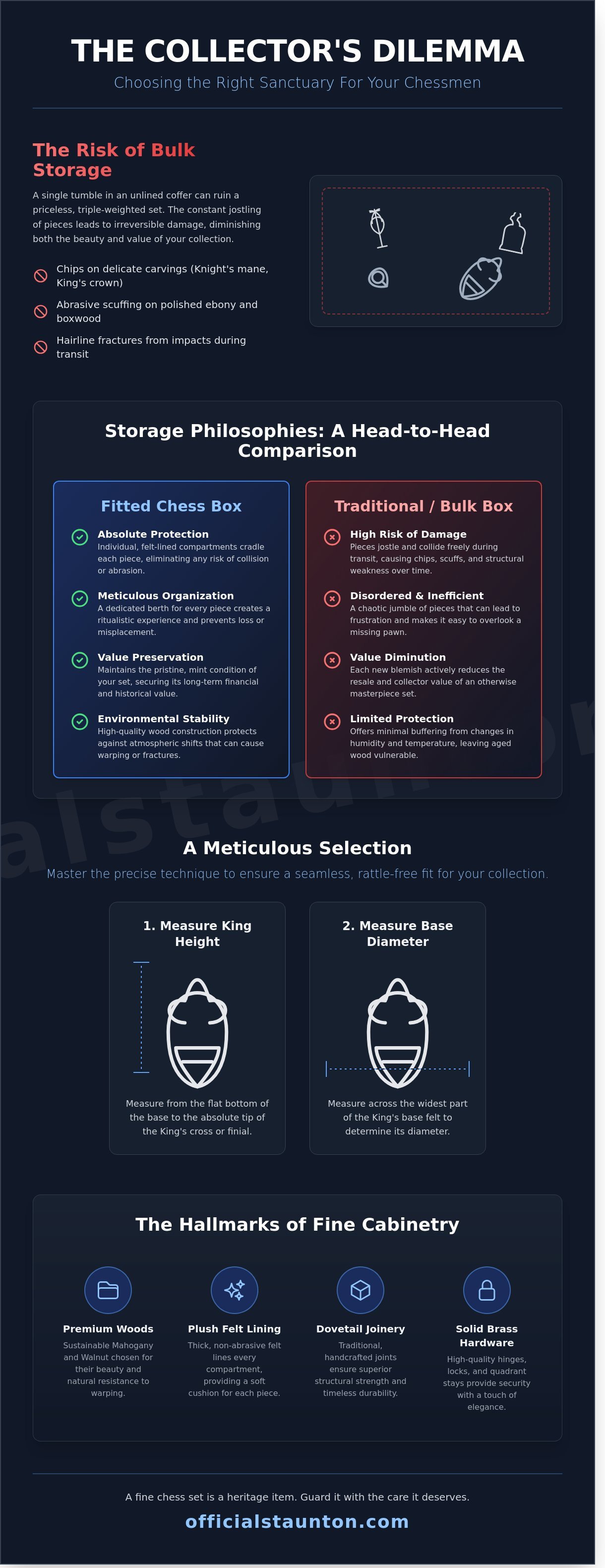
Choosing a sanctuary for your chessmen is a task that requires the same level of precision as the opening moves of a match. A set of fine Staunton pieces represents a significant investment in both art and history, and it deserves more than a simple wooden crate. When you transition to Fitted Chess Boxes, you're opting for a bespoke level of protection where every piece is cradled in its own individual compartment. This prevents the friction and "clinking" that leads to microscopic chips in the polish or, worse, a snapped crown on a King or a broken mitre on a Bishop.
The King is the undisputed ruler of these measurements. You'll need to record his total height, including the cross, and the exact diameter of his base. A 4.0-inch King with a 1.75-inch base won't sit correctly in a box designed for a smaller 3.75-inch set. If the slot is too shallow, the lid won't close; if it's too wide, the piece will shift during transport. Don't overlook the Knight. Artisanal Knights often possess a broader profile or a more aggressive tilt to their heads, which can make them "fatter" than the King's base. If your Knights are particularly ornate, they may require a box with slightly more generous individual bays.
The Pawn test is equally vital for a functional ensemble. While the King must fit without touching the lid, the Pawns shouldn't be buried so deep that they're difficult to retrieve. A well-designed fitted box ensures the smallest pieces remain accessible. Another non-negotiable feature for the modern collector is the 34-slot configuration. Since the late 20th century, premium sets have almost universally included two extra Queens for pawn promotion. A traditional 32-slot box is simply inadequate for a contemporary luxury set, leaving your extra Queens vulnerable and homeless.
A chess set is rarely seen in isolation; it exists as a visual conversation between the pieces, the board, and the storage vessel. Achieving harmony requires a keen eye for timber tones. If you play on a classic Mahogany and Maple board, a Mahogany box provides a unified, traditional look that feels like a singular commission. However, some collectors prefer a more dramatic statement. An ebony-finished box creates a striking, sophisticated contrast when placed alongside a Walnut or Rosewood playing surface, highlighting the deep grains of the wood.
The interior lining is where the true character of the set is revealed. At Official Staunton, we've observed that the most discerning players choose a lining colour that complements the "dark" side of their set. A deep emerald green or a rich royal blue felt provides a stunning backdrop for Boxwood and Ebony pieces. The texture of the lining should be plush enough to absorb vibration but firm enough to maintain the structure of the slots over decades of use. It's these small, thoughtful details that elevate a simple storage solution into a piece of heritage furniture.
If you're ready to provide your set with the protection it deserves, you can browse our range of luxury Fitted Chess Boxes to find the perfect match for your collection.
Selecting the right box is an act of stewardship. It's about ensuring that the hand-carved details of your Knights and the delicate finials of your Kings remain as pristine fifty years from now as they are today. When the wood of the box matches the weight of the history it holds, you've found more than just storage; you've found a legacy. It's a quiet satisfaction, knowing that when you lift the lid, every piece is exactly where it belongs, ready for the next grand encounter.
Selecting a fine chess set is an investment in both history and intellectual pursuit, but the journey of a collector doesn't end once the final piece is polished. At Official Staunton, we view the storage of these instruments as a sacred duty, a philosophy that has led to our curated range of Fitted Chess Boxes. These aren't merely containers; they're handcrafted sanctuaries designed to mirror the elegance of our signature series. By marrying traditional 19th-century joinery with the precision of modern measurements, we ensure that every set, from the humble library size to the grandest ceremonial pieces, remains preserved for generations.
Across the United Kingdom, our storage solutions are regarded as the gold standard for serious enthusiasts. We recognize that a triple-weighted ebony knight or a delicate boxwood queen deserves more than to be rattled about in a felt bag. The structural integrity of our boxes provides a definitive barrier against the humidity fluctuations often found in older British homes, protecting the organic timber from warping or hairline fractures. It's this uncompromising attention to detail that has established our workshop as the primary custodian of the Staunton legacy in the modern era.
For those who possess our 4-inch King sets, the choice often falls between the swirling, complex grains of burl walnut and the deep, reliable warmth of mahogany. Each coffer is lined with a luxurious green baize that prevents even the slightest scuffing of the polished finish. If you're a player who frequents clubs or tournaments, our luxury leatherette cases offer a lighter, more resilient alternative without sacrificing the sophisticated aesthetic. We back the craftsmanship of every unit with a 3-year warranty, reflecting our absolute confidence in the longevity of these materials.
One of the greatest challenges for a collector is finding a home for sets with non-standard silhouettes. Our bespoke internal layouts are specifically engineered to accommodate the unique profiles of the Morphy and Fischer-Spassky series, ensuring that the aggressive tilt of a knight or the flared base of a rook is perfectly supported. There's a distinct tactile joy in the "perfect fit," hearing the soft, muffled thud as a heavy piece finds its designated slot. It provides a sense of order and completion that generic boxes simply cannot replicate. You can Explore our exquisite range of Fitted Chess Boxes to find the exact match for your own collection's requirements.
Another factor worth considering is the duty of care that every player owes to their favourite set. A chess set is a companion through countless battles of wit, and its condition is a reflection of the respect the owner holds for the game itself. When you place your pieces into a dedicated coffer at the end of a match, you aren't just tidying up; you're honouring the artisan who carved them and the history they represent. It's a final, quiet ritual that marks the transition from the heat of competition back to the serene appreciation of functional art. Choosing the right box is the final move in a well-played game, ensuring your set remains as formidable in fifty years as it is today.
Selecting a storage solution isn't merely about finding a place to put your pieces after a match; it's about ensuring their longevity for generations to come. You've seen how the internal architecture of a box, specifically the choice of luxurious linings and precise recesses, prevents the inevitable chipping that occurs in loose coffers. Since 1993, Official Staunton has utilised traditional joinery to create sanctuaries that respect the weight and artistry of your chessmen.
A proper sanctuary must accommodate the exact Staunton pattern dimensions of your set to be truly effective. When each knight and bishop rests in its bespoke cradle, the risk of friction is eliminated. It's a small but vital detail that separates a casual player from a true custodian of the game's history. We offer Free UK Delivery on all our luxury storage solutions, ensuring your collection receives the protection it deserves without delay.
Investing in Fitted Chess Boxes is a commitment to the craft that bridges the gap between the Victorian origins of the 1849 design and your modern study. We invite you to Browse our Heritage Collection of Fitted Chess Boxes and find the final home your grandmaster set requires. Your pieces have served you well on the board; they deserve a rest that is equally distinguished.
You can determine the compatibility of your set by measuring the King's height and base diameter against the internal dimensions of our fitted chess boxes. Most 4-inch Staunton sets require a base clearance of 1.8 inches to sit securely within the individual felted compartments. It's often helpful to allow for a 2mm margin of error to ensure the lid closes without exerting pressure on the delicate finials of your pieces, especially for triple-weighted sets.
A fitted interior represents the pinnacle of protection for luxury sets because it prevents the pieces from colliding and causing minor abrasions during transport. While a sliding lid box offers a classic, utilitarian charm, the individual slots ensure that weighted pieces remain stationary. For a set valued at £500 or more, the investment in a fitted compartment is a prudent choice to preserve the pristine condition of the hand-carved details.
Our contemporary range of fitted chess boxes is meticulously crafted to include two additional slots specifically for the extra Queens provided in modern Staunton sets. Since the introduction of the 34-piece standard in the late 20th century, we've ensured our designs reflect this requirement. Each of the 34 compartments is lined with premium green or red baize to cradle every piece, including the two promotion Queens, in total security.
Mahogany and Walnut stand as the premier choices for storage because of their structural stability and dense grain patterns. These hardwoods possess a natural resistance to warping, which is vital when maintaining the tight tolerances required for a precision-engineered interior. A well-constructed box made from solid 15mm thick kiln-dried timber provides the necessary thermal mass to protect your set from sudden shifts in the British climate.
You can safely store your pieces for decades provided the box is kept in a stable environment with a relative humidity between 40% and 55%. Our artisans use timber that's been seasoned for at least two years to minimise internal tension. This careful preparation ensures that the wood won't crack or contract, keeping the delicate fitted inserts in perfect alignment even as the seasons change in your home.
The high-quality baize lining used in our boxes is entirely safe for antique ivory and bone sets dating back to the 19th century. We avoid acidic adhesives that could cause yellowing or degradation of these organic materials over time. If you own a set from the 1850s, the soft, cushioned interior provides a protective barrier against the micro-scratches that often occur in less sophisticated storage solutions.
The higher cost reflects the intensive manual labour required to hand-finish 34 individual compartments to exacting standards. Unlike a simple hollow box, this style requires an additional 12 hours of artisan craftsmanship to ensure each slot perfectly mirrors the Staunton silhouette. This meticulous process involves precision joinery and the careful application of multiple layers of lacquer, resulting in an heirloom-quality vessel that effectively safeguards your intellectual investment.
