
The tactile weight of a Knight, carved by hand in the tradition of 1849, carries a gravity that no programmed machine can ever replicate. You likely know the disappointment of holding a piece that feels hollow or seeing a grain that looks suspiciously uniform. When you invest in handcrafted wooden chess pieces, you aren't just buying equipment; you're becoming a custodian of a craft that has matured over nearly two centuries. It's about finding that perfect balance between the density of the wood and the delicacy of the carver's chisel.
In this 2026 edition of our guide, we'll explore the meticulous artistry and technical nuances that set world class sets apart from the flood of mass produced alternatives. We'll examine why Ebony remains the gold standard for durability and how to ensure your pieces won't warp or crack when the humidity shifts in your study. You'll also gain the clarity needed to match a set to your existing board, ensuring the King's base occupies exactly 75 percent of the square, just as the masters intended. This guide serves to provide a deep understanding of the Staunton legacy, allowing you to select a set that feels like a genuine piece of history.
To hold a piece from a finely carved set is to feel a direct connection to centuries of intellectual pursuit. While modern manufacturing can churn out thousands of identical plastic shapes in an hour, the creation of handcrafted wooden chess pieces remains a slow, deliberate conversation between the turner and the timber. There is a particular weight and warmth to a hand-finished knight that a machine simply cannot replicate. This tactile soul is what separates a mere gaming tool from a work of functional art.
The distinction lies in the finishing. A machine-turned piece often feels cold and lacks the subtle nuances that a master carver provides. When an artisan works with materials like Grade A Boxwood or Ebony, they aren't just following a template; they are responding to the unique density and grain of that specific block of wood. This results in a set where every piece feels harmonious yet possesses its own individual character.
The year 1849 changed the landscape of the game forever when Nathaniel Cook's design was patented and subsequently produced by John Jaques of London. Before this pivotal date, players struggled with "Barleycorn" or "Selenus" sets that were often top-heavy and easily toppled. The Staunton pattern provided a structural stability and aesthetic clarity that allowed the mind to focus entirely on the 64 squares. It is a design that has stood the test of time, remaining the global benchmark for professional play for over 175 years.
The "Official Staunton" name carries a weight of historical authenticity that serious collectors demand. As we move through 2026, we see a subtle evolution in the Staunton silhouette. Modern sets often feature slightly more robust bases and refined collars, yet they stay fiercely loyal to the Victorian proportions that Cook and Jaques established. This continuity ensures that a set purchased today feels just as relevant as one from the mid-19th century.
Achieving perfect symmetry across a 32-piece set is the ultimate test of a master carver. It is particularly evident in the Knight, which is the only piece that cannot be finished entirely on a lathe. Every mane, nostril, and eye must be carved by hand. One might notice minor variations in the wood grain between two pawns. These are not flaws; they are the fingerprints of authenticity, proving that the set was born from a living material rather than a synthetic mould.
Another factor worth considering is the finish. Budget sets often rely on thick chemical sprays that mask the wood's natural texture. In contrast, investing in handcrafted wooden chess pieces usually means enjoying a surface treated with natural waxes and oils. This meticulous hand-polishing allows the wood to develop a rich patina over decades. As the oils from your hands interact with the timber, the set grows more beautiful with age, transforming from a simple purchase into a genuine family heirloom.
Choosing a set is about more than just finding a way to play the game; it is about selecting a companion for a lifetime of strategy. When you feel the cool, heavy base of a triple-weighted King, you aren't just touching wood. You are holding a piece of history that has been refined by human hands over nearly two centuries.
The selection of timber for handcrafted wooden chess pieces is a decision that echoes through decades of play, as the wood interacts with the natural oils of the hand and the ambient atmosphere of the study. A connoisseur understands that the choice of species dictates not only the visual weight of the set but its physical balance and acoustic properties. High-density hardwoods are preferred for their ability to hold the intricate detail of the Staunton pattern, particularly in the expressive carving of the knights. These exotic materials possess natural oils that provide a built-in preservative, ensuring the timber remains supple and resistant to the brittleness that often plagues inferior, kiln-dried softwoods.
Another factor to consider is how these organic materials respond to their environment. A master craftsman seasons the wood for up to 24 months to reach a stable moisture content of roughly 8 to 10 percent before carving begins. This patience is essential because different woods behave uniquely under varying humidities. While Ebony is remarkably stable due to its high density, it remains sensitive to rapid temperature shifts. Maintaining a consistent relative humidity between 45 and 55 percent in your playing room will prevent the microscopic expansion and contraction that can lead to hairline fractures over a century of use.
Genuine Ebony remains the undisputed sovereign of the dark side, prized for a midnight lustre that appears almost metallic when polished. It's a wood so dense that it famously sinks in water, possessing a specific gravity often exceeding 1.2. In contrast, Bud Rosewood is sought after for its fiery, swirling grain patterns that seem to move beneath the surface of the polish. You can distinguish true heartwood from 'ebonised' boxwood by inspecting the grain under a magnifying lens; genuine Ebony retains a subtle, tight-pored texture, whereas dyed sets often show a uniform, flat black that lacks the soul of the natural timber.
Boxwood provides the essential 'light' side of the board, offering a buttery texture and a fine, non-porous grain that allows for the sharpest possible detail in carving. High-quality Boxwood is identified by its uniform, pale-yellow colour, free from the grey streaks found in younger or poorly harvested samples. For a more relaxed, mid-tier aesthetic, Sheesham, also known as Golden Rosewood, offers a durable alternative with a distinct, wide grain that provides a rustic charm. For those seeking the pinnacle of this craft, exploring the exquisite range of heirloom sets reveals how these materials harmonise in practice to create a balanced field of play.
The tactile difference between these woods is significant. When you lift a triple-weighted Ebony king, the cold, marble-like density provides a sense of authority that lighter woods cannot replicate. This physical presence is a hallmark of handcrafted wooden chess pieces designed for the serious collector. It's a quiet satisfaction, knowing that the timber in your hand has been selected not just for its beauty, but for its ability to endure as a functional legacy for the next generation of players.
While the King and Queen command the board through their stature, the Knight serves as the true arbiter of quality in any premium set. It's the only piece in a collection of handcrafted wooden chess pieces that cannot be fully produced on a lathe. While the other five pieces are shaped by rotation and symmetry, the Knight is a sculpture born from a carver's chisel. This manual process introduces a human element that defines the soul of the entire set.
A connoisseur identifies a master carver by observing the signature left in the fine details. You should look closely at the flare of the nostrils and the depth of the eyes. In the most exquisite sets, the mane isn't just a series of notches but a flowing, textured representation of movement. The ultimate challenge for a workshop lies in the ability to produce four identical Knights. Achieving this level of uniformity across four separate carvings is a feat that separates a standard artisan from a master of the craft.
Design styles often reflect specific eras of play and personal temperament. The Morphy style Knights, which gained prominence in the mid 19th century, lean towards a classical, elegant aesthetic with a more upright posture. In contrast, the Fischer-Spassky designs associated with the 1972 World Championship exhibit a more aggressive, forward leaning stance. This stylistic choice changes the entire energy of the board, moving from Victorian grace to Cold War intensity.
The most difficult elements to perfect are the ears and the delicate bridge of the nose. These areas are incredibly thin, meaning a single misplaced stroke can ruin a piece of boxwood or ebony after hours of work. You'll notice that high end handcrafted wooden chess pieces feature deep, crisp muscular lines in the neck. These details signify the carver's confidence in handling the grain without causing fractures, a skill that takes years to master.
The original 1849 Staunton Knight drew direct inspiration from the Selene horse found among the Elgin Marbles in the British Museum. This classical lineage continues through various interpretations like the 1950 Dubrovnik series, which offers a more minimalist, stout personality that famously captivated Bobby Fischer. Collectors often gravitate toward our Collector Series for its uncompromising commitment to 19th century accuracy, ensuring every curve mirrors the heritage of the Victorian masters who first defined the game's modern aesthetic.
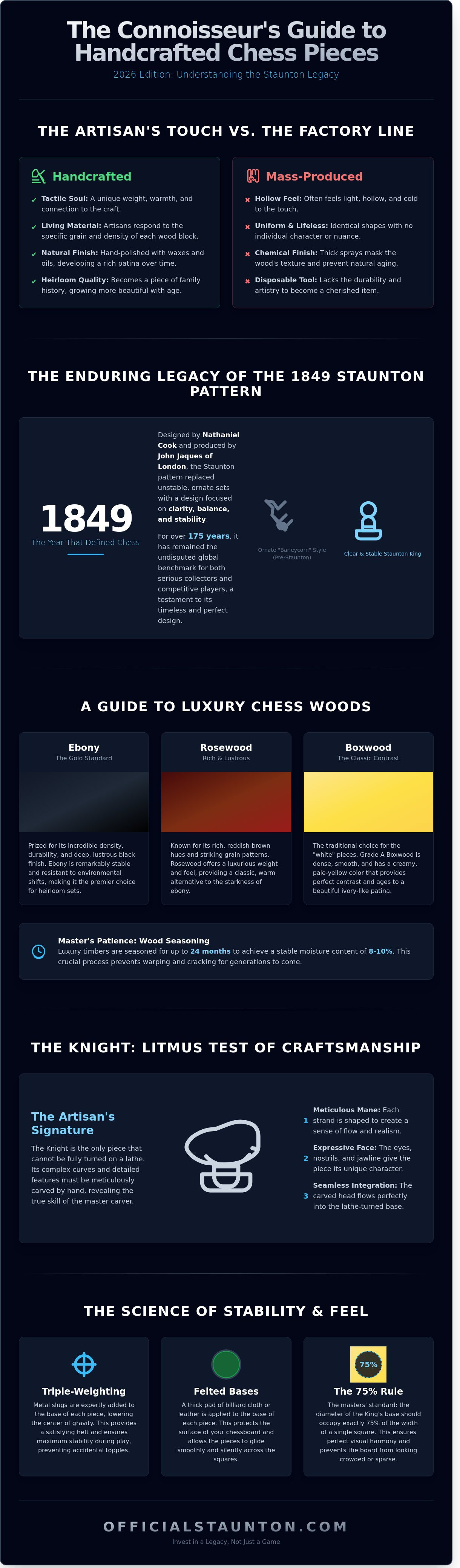
For the serious player, the true soul of handcrafted wooden chess pieces resides in their physical gravity. It isn't merely about the visual silhouette; it's about how a piece responds when you lift it from the board. A well-balanced piece possesses a low centre of gravity that anchors it to the square, ensuring it won't topple during a tense blitz game or a contemplative classical match. This stability is achieved through meticulous internal weighting, a process that separates a mere toy from a professional instrument.
The choice between double and triple weighting often comes down to personal preference, though the latter is frequently favoured in luxury circles. A triple-weighted King, often reaching a substantial 90 to 110 grams, provides a reassuring heft that communicates quality through the fingertips. There's a specific auditory satisfaction, a resonant 'clack', when a weighted piece is placed firmly on a solid wood board. This sound is as much a part of the game’s tradition as the opening theory itself, providing a sensory punctuation to every strategic decision.
Crafting a balanced piece requires more than just adding mass. Artisans must precisely drill the base to accommodate lead or iron weights, which are then sealed permanently to prevent the dreaded 'rattle' found in inferior sets. If the weight isn't perfectly centred, the piece will lean, ruining the aesthetic alignment of the ranks. In a standard 4.0-inch Staunton set, the base diameter must be wide enough to support this internal ballast without looking bottom-heavy. This geometric harmony ensures that even the most delicate movements feel deliberate and controlled.
The base of each piece is traditionally finished with high-quality billiard cloth, often referred to as baize. While green is the classic choice, many modern connoisseurs prefer black or deep burgundy to complement darker woods like ebony. This felt serves two vital purposes: it protects the polished surface of your board from scratches and dampens the sound of play to a sophisticated thud. A premium felt allows the piece to glide across the wood, facilitating those smooth, sliding captures that feel so satisfying during a match.
The final tactile element is the finish. Whether you prefer the mirror-like shine of high-gloss lacquer or the understated elegance of a satin buffed-wax finish, the wood must feel organic and warm to the touch. A satin finish is often preferred by those who play frequently, as it hides fingerprints and allows the natural grain of the boxwood or rosewood to remain the star of the show. You can explore these textures further by browsing our collection of luxury weighted chess sets to find the perfect balance for your study.
Choosing the right weight and finish is a deeply personal decision that affects every minute of your time at the board. When a piece feels right in the hand, it ceases to be an object and becomes a natural extension of your thoughts. This physical connection is what makes handcrafted wooden chess pieces a lifelong investment for any dedicated player.
Choosing a set is an act of stewardship. Since our establishment in 1993, Official Staunton has operated as the primary custodian of the 1849 design, ensuring that the proportions first championed by Nathaniel Cook and Howard Staunton remain preserved for the modern era. We don't view these sets as mere commodities. Instead, we treat every selection of handcrafted wooden chess pieces as a functional piece of history, carved with the same reverence for the form that defined the Victorian golden age of chess.
Quality manifests in the details that a casual observer might miss, such as the precise weighting of a knight or the depth of the carving on a king's crenellations. Because we use ethically sourced timbers like Grade A Ebony and sustainably harvested Boxwood, the wood requires time to settle. This organic nature is why we provide a 3-year warranty on our sets. It's a commitment that acknowledges wood as a living material which reacts to its environment, giving you the confidence that your investment is protected against the natural stresses of time and climate.
Another factor worth considering is the physical harmony between the pieces and their theatre of play. A common oversight is pairing a magnificent set with a board that stifles its presence. We generally recommend that the base of the King should occupy approximately 75 percent of the square's width. For a standard 95mm King, a board with 55mm squares usually provides the necessary breathing room for the pieces to be admired without feeling crowded during a complex middle-game transition.
Our bespoke 'Series' guides are designed to help you navigate our various historical recreations, from the stout 1851 Morphy sets to the elegant 1860 Leuchars. It's often wise to match the dark wood of your pieces to the wood used in the border or the dark squares of your board to create a cohesive aesthetic. If your collection ever suffers the wear of decades of use, our specialist restoration services can breathe life back into tired finishes, preserving the integrity of the grain for the next generation of players.
Our sets aren't just for display; they're the preferred choice for grandmasters and serious collectors who require a specific tactile response during play. Being a UK-based specialist since 1993 means we understand the nuances of the British chess tradition better than anyone else. This leads to an interesting point regarding authenticity. When you see our hallmark, you're seeing a promise of historical accuracy and artisanal excellence. We invite you to explore our exquisite range of handcrafted wooden chess pieces and find the set that will define your study for years to come.
Owning a fine chess set is a rare pleasure that grows as the wood develops its own unique patina over time. It's a reminder that in an increasingly digital world, there is still a profound, quiet joy to be found in the weight of a well-carved piece and the soft thud of it landing on a wooden board.
Selecting a set isn't just about the immediate requirements of play; it's an act of curation that considers how the natural grain of the timber feels against your palm during a quiet hour of study. When you examine the intricate hand-carving of a knight or the precise weighting of a king, you're seeing a design evolution that traces back to the original 1849 standards. These handcrafted wooden chess pieces offer a tactile satisfaction that mass-produced alternatives can't replicate. It's the difference between a simple tool and a functional masterpiece that's built to outlast the table it sits upon.
At Official Staunton, we've remained dedicated custodians of this artistry since 1993, ensuring every boxwood or ebony set meets the standards of the most discerning collector. We understand that investing in such craftsmanship requires confidence, which is why we provide a 3-Year Warranty on all our wooden pieces. Our team manages worldwide shipping from our UK centre to ensure your acquisition arrives in pristine condition. There's a profound joy in finding the right balance of timber and weight that resonates with your style.
We invite you to Discover our heritage collection of handcrafted wooden chess pieces and find the set that speaks to your own sense of history. Your next great game deserves a companion that's as thoughtful as your opening move.
Boxwood and Ebony remain the gold standard for premium sets due to their exceptional density and fine grain. Genuine Ebony, often sourced from regions like India or Madagascar, offers a natural weight and a deep, lustrous black that feels substantial in the hand. For the light side, Boxwood is preferred because its tight pores allow for the intricate detail seen in the 1849 Staunton design. You'll find these materials have a Janka hardness rating exceeding 2,500 lbf, ensuring they withstand decades of play.
The most reliable way to identify handcrafted wooden chess pieces is to examine the Knights for subtle, unique variations. Since a master carver spends roughly 10 to 12 hours on a single Knight, no two pieces will ever be identical twins. You might notice a slight difference in the tilt of a mane or the curve of a nostril. If every piece looks mathematically perfect, it's likely the product of a computer-controlled CNC machine rather than an artisan's chisel.
The cost is primarily driven by the complexity of the Knight and the rarity of the timber used. A set featuring a "Cook" style Knight requires a level of artistry that only about 5% of carvers globally can achieve. When you combine this skill with the price of Grade A Ebony, which has risen by 15% since 2023, the investment reflects both material scarcity and hundreds of hours of manual labour. It's the difference between a mass-produced tool and a legacy heirloom.
Weight provides the physical stability and tactile "thud" that defines a professional playing experience. Most connoisseurs prefer a triple-weighted set, where the total weight of the pieces reaches approximately 1.8 kilograms. This internal lead weighting prevents pieces from tipping over during a blitz game or a stray sleeve movement. It's quite satisfying to feel that low centre of gravity when you're placing a piece firmly on the board to announce a check; it adds a layer of authority to your move.
You should use a dry, soft microfibre cloth for regular dusting and a tiny amount of high-quality beeswax once every 12 months. Avoid using water or chemical sprays, as these can seep into the grain and cause the wood to crack or swell over time. I've seen sets from the late 19th century that still look magnificent simply because their owners kept them away from direct sunlight and maintained a consistent humidity level of around 45% to prevent the timber from drying out.
A King with a 4-inch height typically requires a board with 55mm or 60mm squares to ensure the pieces don't feel cramped. The professional standard suggests that the base diameter of the King should occupy about 75% to 80% of the square's width. If you choose a board that's too small, the battlefield becomes cluttered; too large, and the pieces look lost. It's a delicate balance that affects both the aesthetics and your spatial awareness during a match.
Official Staunton maintains a dedicated archive for our premium collections, allowing us to provide individual replacements for most of our signature designs. Because each batch of wood varies in colour and grain, we often ask for a photo of your existing pieces to ensure the best possible match. It's a common worry for players, but since we've been custodians of these designs for decades, we make it a priority to help you keep your set complete rather than leaving it as a fragmented relic.
Ebony is a naturally black, incredibly dense hardwood, while ebonised Boxwood is a lighter wood that has been treated with a chemical stain to mimic the appearance of Ebony. You can tell the difference by looking at the weight and the wear; ebonised pieces are significantly lighter and may show the natural boxwood colour if they get chipped. While ebonised sets provide a classic look at a lower price point, they lack the cold, stone-like feel of genuine Gaboon Ebony, which is prized by collectors.
