
A true masterpiece of the 1849 design isn't merely a tool for play; it's a silent witness to history that commands the room before a single pawn has moved. For the discerning collector, few things are as disappointing as investing in what is marketed as a luxury item only to discover it's a hollow, poorly weighted imitation that lacks the gravitas of a genuine premium staunton chess set. You likely already appreciate that the tactile weight of a triple-weighted piece and the subtle grain of ebony are essential to the quiet authority of a grandmaster's game.
This guide will demystify the nuances of selecting a world-class set, focusing on the specific wood densities and meticulous hand-carving standards that define our collective heritage. We'll explore how to match your board to the precise 55mm square size required for a 95mm King to ensure it remains a stunning centrepiece. By the end, you'll understand how to identify a set that serves as both a tournament-ready tool and a functional piece of art that will appreciate in sentimental value for generations.
To the untrained eye, any set featuring a cross on the King and a mitre on the Bishop might appear to be a Staunton. However, those who appreciate the finer nuances of the game understand that the label often masks a wide gulf in quality. A true premium staunton chess set isn't merely a collection of pieces; it's a meticulous recreation of the 1849 standard originally registered by Nathaniel Cook. This specific design didn't just happen by accident. It was a deliberate move to bring order to a chaotic world of disparate regional styles that existed in the early 19th century.
At Official Staunton, we view ourselves as custodians of this specific historical legacy. We ensure that the proportions and weights remain faithful to the Victorian ideals of balance and poise. When you handle a piece from a high-tier set, you aren't just playing a game. You're engaging with a tradition that has remained the pinnacle of functional chess aesthetics for over 170 years. This commitment to authenticity is what separates a generic replica from an investment in both strategy and artistry.
The distinction between a standard pattern and a premium handcrafted recreation often comes down to the level of human intervention. While mass-produced sets rely on automated lathes that strip away the character of the wood, a premium set requires dozens of hours of manual carving. This process ensures that every curve of the Bishop's mitre and every ridge on the Rook's parapet is executed with a level of precision that machines simply cannot replicate.
The soul of any high-tier set resides in the Knight. While budget versions often look like generic caricatures, a premium recreation draws inspiration from the Elgin Marbles, featuring a mane that flows with lifelike grace. The Rook's castellation must feel substantial, evoking the permanence of a fortress rather than a flimsy toy. Symmetry in the King and Queen serves as a marker of elite production, where the lathe-work is so precise that the balance feels instinctive. A serious player desires a set that feels correct in the hand, where the weight is distributed to prevent tipping during a tense blitz match.
Choosing a set of this calibre represents a transition from owning a temporary gaming tool to possessing a permanent family centrepiece. Professional-grade materials like genuine Ebony or Grade-A Boxwood are selected for their ability to resist warping over many decades. We often discuss the luxury chess sets philosophy of buying once and cherishing forever. These pieces are designed to be played with, eventually gaining a unique patina that tells the story of every match contested upon the squares. It's an investment that matures alongside the player's own mastery of the game.
The tactile experience of a premium staunton chess set begins with the choice of timber, where the distinction between a standard set and a masterpiece becomes immediately apparent. While ebonised boxwood serves the casual player well, the connoisseur seeks the uncompromising density of genuine Grade-A Madagascar Ebony. This wood offers a natural, jet-black depth that industrial dyes cannot replicate. When you hold an ebony piece, you feel a cool, marble-like temperature that persists even during a heated match; a sensation quite different from the lighter, stained alternatives.
To achieve the "planted" feel required for both blitz and classical play, each piece undergoes a process of triple-weighting. We ensure that a lead weight is securely housed within the base, shifting the centre of gravity lower. This prevents the pieces from toppling during a rapid exchange or a decisive 40th move. A King in a high-quality set might weigh upwards of 95 grams, providing a satisfying resistance when lifted from the board. This stability is complemented by the base protection; while many use thin felt, a truly premium staunton chess set will feature thick, billiard-grade cloth or even Italian leather pads to ensure the pieces glide silently across a wooden board.
The finish of the wood is where the artisan's hand is most visible. Rather than masking the timber under thick, industrial lacquers that can chip or yellow over time, we advocate for hand-polishing with natural waxes. This method allows the wood to breathe and develop a unique patina over decades of use. It results in a soft, satin lustre that highlights the intricate grain rather than hiding it under a plastic-like shell.
The contrast between the light and dark pieces defines the visual rhythm of the game. Bud Rosewood is often favoured for its deep, wine-red hues and swirling grain patterns, which provide a stunning counterpoint to the creamy, buttery texture of Boxwood. Beyond aesthetics, the density of these hardwoods affects the acoustic "thud" of a move. There is a specific, resonant sound when a heavy Rosewood piece meets a solid board that signals a move of intent. You might also notice a subtle, earthy scent when first opening the box; a natural characteristic of fine hardwoods that reminds you of the set's organic origins.
The Knight remains the ultimate test of a master carver’s skill, often requiring several days of meticulous work for a single set. Because these are carved by hand, no two premium Knights are ever identical; slight variations in the flare of a nostril or the curve of a mane add a unique character that machine-made sets lack. This level of detail ensures the pieces are not just beautiful to look at, but also ergonomically sound. The bevelled edges and precise proportions are designed to fit the natural grip of the fingers, making the physical act of playing as rewarding as the strategy itself.
Choosing a specific series is perhaps the most intimate stage of acquiring a premium staunton chess set. It is the moment where you decide which era of grandmastery will reside in your home, as each collection carries its own weight of history and distinct tactile personality. For many enthusiasts, the pull of the nineteenth century is irresistible, offering a connection to the romantic era of the game where flair and daring sacrifices were the order of the day.
The Morphy Series Chess Pieces serve as a poignant tribute to Paul Morphy, the mid-Victorian genius often called the "Pride and Sorrow of Chess." These pieces are a masterpiece of mid-Victorian artistry, featuring an ornate, classical profile that feels delicate yet commanding. The Knights, in particular, are carved with a level of detail that captures the spirited nature of Morphy’s own playing style, making them a favourite for those who appreciate the aesthetic of the 1850s.
For the purist who seeks the definitive 1849 experience, the Collector Series remains the benchmark. These represent the quintessential staunton chess pieces, prioritising the balance and proportions that first established the Staunton pattern as the global standard. There is a quiet majesty in the old-world aesthetic of these sets. When placed in a modern study or a traditional drawing room, they act as a focal point of intellectual prestige, inviting a slower, more thoughtful pace of life.
As we move into the mid-twentieth century, the design language of the premium staunton chess set evolves to reflect the geopolitical tensions and artistic shifts of the time. The Dubrovnik series is perhaps the most famous departure from the Victorian norm. Originally designed for the 1950 Chess Olympiad in Yugoslavia, these pieces are celebrated for their stout, purposeful profile and the notable absence of religious symbols on the King and Queen. It is well-documented that Bobby Fischer considered the 1950 Dubrovnik his favourite playing set, often praising its substantial feel and the way the pieces seemed to command the squares.
Another era-defining design is the Fischer-Spassky set, which recreates the atmosphere of the 1972 World Championship in Reykjavik. This collection captures the brutalist yet elegant design philosophy of the Cold War era. The pieces are weighted for stability and designed for the high-stakes environment of international competition. Selecting a series is ultimately about finding a narrative that speaks to you. You might find yourself drawn to the following considerations:
The Official Staunton hallmark ensures that these historical recreations are faithful to the original specifications, maintaining the integrity that a true connoisseur expects. Whether you are drawn to the ornate carvings of the Victorian age or the functional elegance of the twentieth century, your choice should reflect a personal connection to the story the pieces tell. A well-chosen set does more than occupy a board; it invites you to participate in a lineage of play that spans centuries.
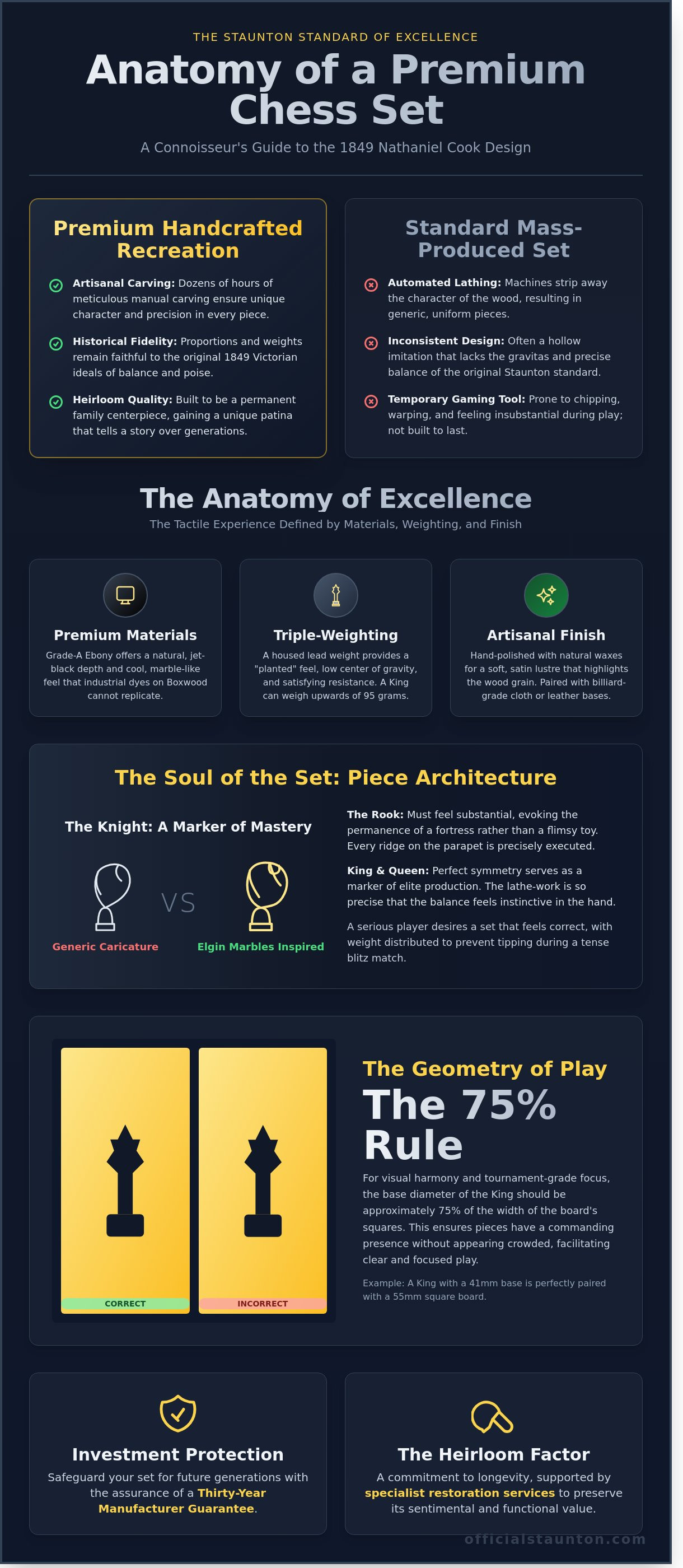
Selecting a premium staunton chess set is only the first half of a connoisseur's journey. The true mastery lies in the marriage between the pieces and the field of battle. A common oversight involves neglecting the spatial relationship between the King's base and the dimensions of the square, which can lead to a cluttered, claustrophobic aesthetic. To achieve the perfect balance, one should adhere to the 75% rule; this suggests that the diameter of the King’s base should occupy approximately three-quarters of the square’s width. This precise ratio ensures the board feels populated yet breathable, allowing the intricate carvings of the knights to be admired without visual interference from neighbouring pieces.
The choice between a traditional framed board and a contemporary borderless design also alters the psychological weight of the game. A framed board, often featuring a wide mitred edge, acts as a physical boundary that focuses the mind entirely on the 64 squares. In contrast, borderless designs offer a seamless, expansive feel that suits modern interiors. You'll find that overcrowding the squares with oversized pieces is a mistake that even seasoned collectors sometimes make. It disrupts the flow of the game and makes it difficult to navigate the board during the heat of a complex endgame.
For those who appreciate the weight of history in their hands, a 3.75-inch or 4-inch King remains the gold standard for serious play. These heights offer a commanding presence on the board, echoing the proportions used in prestigious international tournaments. When you pair these pieces with a 50mm or 55mm square, you create an environment that enhances spatial awareness. It isn't just about looks; the proper spacing prevents accidental piece collisions during a tense exchange. This breathing room allows each piece to retain its individual silhouette, which is vital for quick pattern recognition during play.
The visual dialogue between the timbers is where a set truly comes to life. If you've chosen a set crafted from deep, dark Ebony, it demands a high-contrast companion such as a Maple or Macassar Ebony board to highlight the grain. For a softer, more traditional atmosphere, a Walnut board paired with Boxwood pieces offers a warmth that evokes the quiet libraries of the Victorian era. You can explore our wooden chess boards guide for a more technical analysis of how different timber grains interact under various lighting conditions.
Once the pairing is finalised, remember that a premium staunton chess set deserves a bespoke storage solution. A fitted mahogany box or a handcrafted coffer lined with billiard cloth ensures that the delicate carvings, particularly the fragile crenellations of the rooks, remain protected for generations. It's a small but vital investment in preserving the integrity of the artisan's work. This level of care reflects the respect we hold for the game's long and storied heritage.
Discover the perfect foundation for your collection by browsing our exclusive range of luxury chess boards.
The relationship between the board and the pieces is a silent conversation that defines the entire playing experience. When the weights, textures, and dimensions align, the act of moving a piece becomes more than just a tactical decision; it becomes a tactile pleasure. This harmony is what separates a mere game from a true heirloom experience, ensuring that every match played is framed by beauty and precision.
Acquiring a premium staunton chess set is rarely a simple transaction; it is the beginning of a multi-generational narrative. Our role as a specialist UK manufacturer, with a history spanning over 30 years, provides a level of security that a general luxury boutique cannot replicate. We don't just supply pieces. We offer a comprehensive restoration service to ensure that if a knight’s mane is chipped or a base felt wears thin after decades of intense play, your investment can be returned to its original glory by the same hands that understood its creation. This long-term commitment transforms a purchase into a protected asset.
Every set we produce carries the weight of this heritage. Authenticity is verified through branded hallmarks and individual certificates that track the lineage of the design back to the original 1849 standards. It’s a level of detail that matters when you consider that these sets often become the centrepiece of a study or a family library. You aren't just buying wood and lead weighting; you're securing a piece of history that has been vetted by experts who live and breathe the nuances of the Staunton form.
Choosing a set from a dedicated chess historian offers advantages that go far beyond aesthetics. We understand the technical requirements of a tournament-grade balance, something a general retailer might overlook in favour of mere shelf appeal. Our timbers, including the finest Grade-A Ebony and Boxwood, are sourced through strictly ethical channels, adhering to CITES regulations and sustainable forestry practices. This ensures your set is as responsible as it is beautiful. We view our relationship with clients as a consultation. If you're unsure which wood grain complements your walnut table, we're here to advise based on decades of interior and historical knowledge, rather than simply pushing for a sale.
Preserving the integrity of fine wood requires a small amount of regular attention. Using the correct chess accessories, such as a high-quality storage coffer and soft polishing cloths, will prevent the accumulation of oils and dust. It's vital to keep your premium staunton chess set away from direct sunlight and sharp fluctuations in humidity, as natural materials like Ebony can be sensitive to extreme British winters or dry central heating. A simple humidifier in the room can make all the difference in preventing hairline cracks over time.
There is a unique satisfaction in watching a well-loved set evolve. Unlike modern plastic alternatives, a fine wooden set improves with the patina of age, absorbing the history of every match played upon it. The way a weighted king feels in the hand or the soft thud of a piece landing on a leather-lined board creates a sensory experience that only deepens over the years. Eventually, the set becomes more than the sum of its parts, standing as a silent witness to countless hours of intellectual pursuit and quiet reflection.
Choosing a premium staunton chess set represents a commitment to an artistic tradition that has defined the game since the Victorian era. It's a decision that moves beyond mere utility, focusing instead on the tactile weight of triple-weighted pieces and the silken finish of ethically sourced hardwoods. Since 1993, Official Staunton has served as both designer and manufacturer, ensuring that every knight's mane and every bishop's mitre adheres to the exacting standards of the 1849 original. This dedication to excellence extends to our specialist restoration services, where we breathe new life into cherished heirlooms that have witnessed a lifetime of strategic battles.
The journey toward finding a set that resonates with your personal style requires a quiet appreciation for the nuances of wood grain and the historical narratives of specific collections. When you invest in a masterpiece from our workshop, you're not just purchasing a product; you're becoming a part of a lineage of connoisseurs who value authenticity above all else. We hope you find the centrepiece that will define your study and your play for generations to come.
Explore the Exquisite Collections at Official Staunton
A premium staunton chess set is defined by the meticulous hand-carving of the pieces, particularly the Knight, and the use of rare, dense hardwoods like Grade-A Ebony. While standard sets are often mass-produced on lathes with minimal finishing, a high-end set undergoes over 40 hours of artisanal refinement to ensure the proportions mirror the 1849 original. The precision of the collars, the sharpness of the Bishop's mitre, and the seamless integration of internal lead weights distinguish these masterpieces from common alternatives.
Triple-weighting provides the gravitational stability required for a confident, tactile experience during a serious match. By adding approximately 1.5 kilograms of lead to a full set of pieces, the centre of gravity is lowered significantly, which prevents the pieces from toppling if they're accidentally brushed by a sleeve. This physical heft is a hallmark of quality that transforms a simple game into a more deliberate and prestigious ritual, ensuring each move feels grounded and intentional.
Genuine African Ebony paired with high-grade Boxwood remains the gold standard for any premium staunton chess set due to its immense density and natural lustre. For the dark pieces, Rosewood or Padauk offer a striking alternative with rich, visible grains that develop a deep patina over time. These specific timbers are seasoned for at least 2 years before carving to ensure the wood doesn't crack when exposed to the varying humidity levels found in UK homes.
The most reliable method is to follow the FIDE guideline where the King's base diameter occupies roughly 75% to 78% of the square's width. For a standard 4 inch King with a 1.75 inch base, a board with 55mm or 60mm squares is the ideal pairing. This specific ratio ensures the pieces aren't cramped, allowing the intricate details of the carving to be appreciated without the board appearing cluttered or overcrowded during the endgame.
Most high-end sets are designed to meet strict FIDE regulations, provided they maintain the classic Staunton silhouette and appropriate weighting. Official Staunton pieces often feature the 3.75 inch or 4 inch King height required for competitive events in the UK and abroad. While they're undoubtedly pieces of art, their balance and heavy felted bases make them perfectly functional for the rigours of a 90 minute clock game where stability is paramount.
An authentic reproduction will mirror the specific hallmarks of the original Nathaniel Cook design, such as the distinct "miter" on the Bishop and the specific curvature of the Rook's battlements. You should look for the King's side stamping on the Rook and Knight, a tradition dating back to the mid-19th century to help players orient the board. Official Staunton pieces include a certificate of authenticity to verify the historical accuracy of the carving style and the provenance of the materials used.
Genuine Ebony is a naturally black, incredibly dense hardwood, while Ebonised Boxwood is boxwood that's been treated with a deep black stain to mimic the appearance of Ebony. While ebonising provides a similar aesthetic at a more accessible price point, it doesn't possess the same 1.2 specific gravity or the characteristic cold-to-the-touch feel of real Ebony. Over 20 or 30 years, real Ebony develops a unique, organic sheen that a surface stain simply cannot replicate.
You should gently buff the pieces with a soft microfibre cloth and a tiny amount of high-quality Renaissance Wax every 6 months to preserve the timber. It's vital to avoid using water or household detergents, as these chemicals strip the natural oils from the wood grain and can cause permanent damage. Storing the set away from direct sunlight and radiators prevents the timber from expanding or contracting, a process that can lead to hairline fractures in the base of the pieces.
