
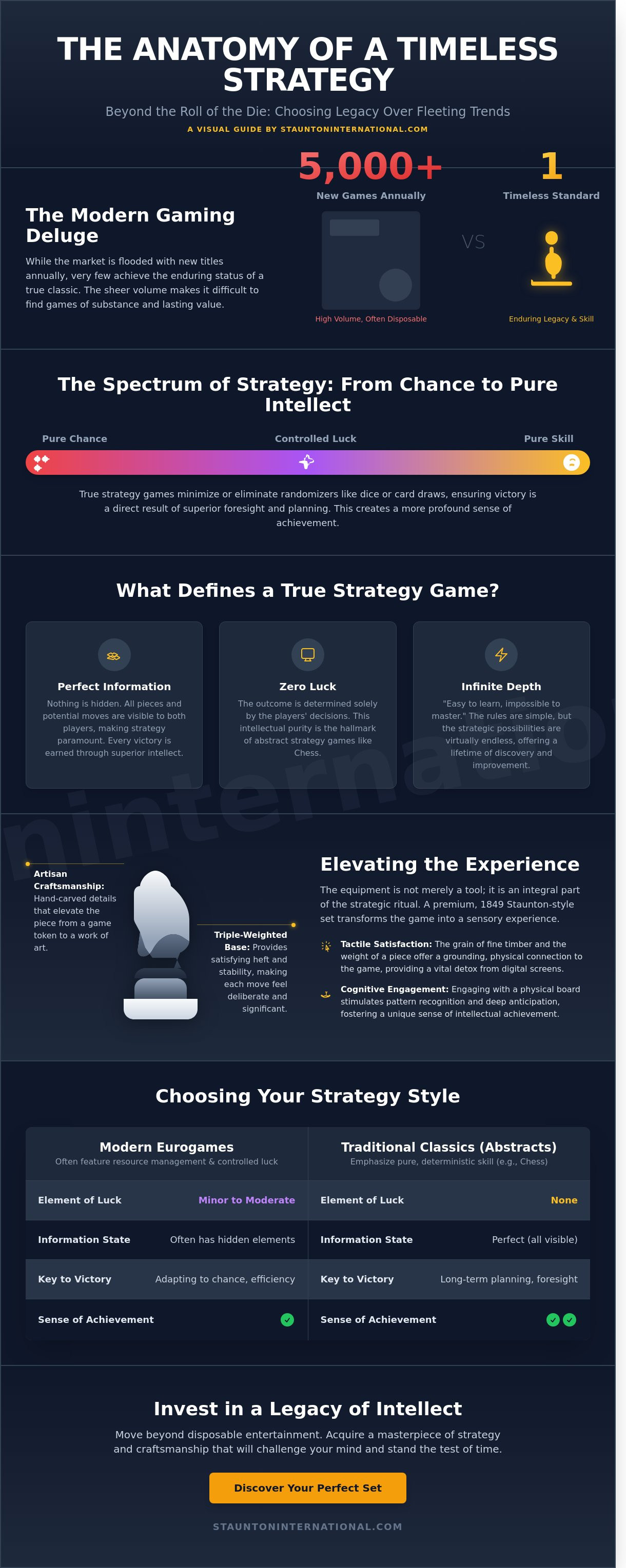
The most profound intellectual battles aren't found in the flashing lights of a digital screen or the flimsy cardboard of a seasonal trend. It's a sobering thought that while over 5,000 new strategy board games are released annually, very few possess the historical gravity to survive even a single decade. You've likely grown weary of disposable titles that rely on the fickle roll of a die rather than the deliberate weight of a well-considered move. You might be wondering why some pursuits feel like mere distractions while others feel like a legacy.
This guide explores the transition from fleeting amusement to the acquisition of a permanent, functional masterpiece. You'll discover why a commitment to the 1849 Staunton design offers a depth of skill and a level of artistry that modern alternatives simply cannot replicate. We'll explore the nuances of hand-carved wood grain, the tactile satisfaction of a triple-weighted base, and the enduring appeal of a game where victory is earned entirely through wit.
The allure of sophisticated strategy board games resides in the quiet triumph of the intellect over the caprice of fortune. While many traditional pastimes rely upon the roll of a die or the chance draw of a card, a true strategy game demands a profound shift toward pure intellectual skill. This transition elevates the experience from a mere diversion to a disciplined pursuit of logic and foresight. The most revered titles in this genre are those that present a transparent landscape, often referred to as perfect information, where nothing is hidden from the participants. This transparency ensures that the burden of victory rests solely upon the player's foresight, a quality that separates a mere pastime from a true Strategy game.
To better understand the nuanced relationship between accessible rules and profound depth, watch this helpful video:
The most enduring examples of the craft are those that adhere to the principle of "easy to learn, impossible to master." This philosophy allows a novice to grasp the mechanics within minutes, yet provides a lifetime of discovery through infinite depth. When a game removes the veil of chance, it fosters a unique environment for critical thinking and long-term planning. You might find that the satisfaction derived from these games stems not from a lucky break, but from the meticulous assembly of a plan that spans dozens of moves. It is a testament to human wit that sets from the 1849 Victorian era continue to be the standard for those who appreciate this level of mental engagement.
Engaging with complex strategy board games triggers a fascinating cognitive process where the brain begins to recognise patterns and anticipate an opponent’s reactions several layers deep. This mental stimulation provides an emotional satisfaction that few other hobbies can replicate, as the execution of a well-conceived plan releases a sense of genuine achievement. For many professionals, these sessions serve as a vital digital detox. The tactile nature of moving a weighted piece across a wooden board offers a grounding experience that modern screens cannot provide. This rhythmic pace mirrors the slow, thoughtful deliberation required of a grandmaster, making it a preferred choice for those who value intellectual prestige.
The distinction between "Eurogames," which may incorporate a minor element of controlled luck, and "Abstracts," which eliminate chance entirely, is a topic of great interest to the serious collector. While a randomiser like a die can provide variety, the connoisseur often gravitates toward games without such devices to ensure a more profound sense of personal achievement. This preference for skill over chance is why many seek out antique chess sets and similar traditional equipment. When the "randomiser" is removed, every success is earned through merit. This uncompromising standard of play ensures that the integrity of the game remains intact, anchoring the modern player to a heritage of excellence that has persisted for centuries.
The origins of tabletop strategy are not found in the brightly coloured boxes of the modern high street, but rather in the dust of ancient civilisations where play was a serious rehearsal for statecraft. These early games functioned as sophisticated simulations, allowing rulers and generals to test their tactical acumen without the immediate risks of the battlefield. Historical records, such as those detailing 2,000 Years of Board Games, reveal that from the Roman Empire to the courts of the Middle Ages, the act of moving pieces across a grid has always been an intellectual pursuit of the highest order. Over centuries, these military training tools slowly transitioned into social pastimes, yet they never lost their reputation as the ultimate test of human wit.
Most historians agree that the lineage of modern strategy board games can be traced back to Chaturanga, a 6th-century Indian game that represented the four divisions of the military: infantry, cavalry, elephants, and chariots. As this game migrated along the Silk Road, it underwent a fascinating metamorphosis to suit the cultural landscapes it encountered. In Persia, it became Shatranj, and upon reaching Europe, the pieces were reimagined to mirror the feudal hierarchy of the time. You can still witness this evolution by examining antique chess sets, which serve as physical archives of how rules and aesthetics shifted to meet the demands of different eras. These historic sets remind us that before the advent of rigid rulebooks, the game was a living, breathing reflection of the society that played it.
By the early 19th century, the lack of a universal design for playing pieces had become a significant hurdle for the growing international community. Players often found themselves confused by regional variations like the spindly Barleycorn sets or the overly ornate St. George patterns, which were frequently unstable and difficult to distinguish during a tense match. This changed in 1849 when Nathaniel Cooke introduced a design that prioritised function, stability, and elegance. He was joined by Howard Staunton, the leading chess authority of the day, who lent his name and endorsement to the set. This partnership created a standardised "language" for the board, ensuring that a player from London could sit across from a player from St. Petersburg and immediately understand the state of the game.
The Staunton design was more than a mere product; it was a masterstroke of Victorian engineering and artistry. By utilizing a wide base and a distinct silhouette for each piece, the 1849 design eliminated the ambiguity that had plagued the game for centuries. This standardisation laid the groundwork for modern competitive play and established the aesthetic that remains the benchmark for quality today. If you appreciate the weight of history in your hands, you might find that owning a reproduction of the original 1849 set provides a much deeper connection to the tactical thinkers of the past. The enduring influence of these traditional designs proves that while the themes of our games may change, the fundamental desire for clarity and craftsmanship is timeless.
The discerning player often finds themselves at a crossroads between the vibrant, narrative-driven world of modern titles and the austere, intellectual rigour of the classics. While the landscape of strategy board games has shifted significantly since the mid-1990s, the core appeal remains the same. It is a quest for mental stimulation and the quiet satisfaction of a plan well executed. Choosing between a contemporary Eurogame and a traditional set involves deciding what kind of atmosphere you wish to cultivate at your table.
Investment value is another factor that separates these two worlds. A modern game, often made of cardboard and plastic, provides immediate entertainment but may lose its lustre as the next "hot" title arrives. In contrast, a hand-carved wooden set is a heritage piece. These items don't just sit on a shelf; they accrue sentimental and aesthetic value over decades. The physical weight of a triple-weighted knight or the snap of a high-quality tile changes the very nature of the evening, turning a simple hobby into a ritual of sophistication.
Modern Eurogames have redefined how we interact across the table by moving away from direct conflict toward resource management. In a game like Catan, which has sold over 32 million units since its 1995 debut, players focus on building their own "engines" rather than simply capturing an opponent's pieces. This shift reflects a broader evolution of board games where the social experience is just as vital as the victory conditions.
You might find these modern titles particularly suitable for casual family gatherings where the goal is engagement rather than intense rivalry. Because many of these games use "catch-up" mechanics, they keep all players involved until the final moments. This differs from the traditional duel, where a single mistake in the opening can lead to a long, inevitable defeat. For a lively dinner party, the colourful boards and varied components of a thematic game offer a sense of novelty that is hard to ignore.
There is a reason why Chess and Backgammon have survived for centuries while thousands of other strategy board games have vanished into history. They possess a purity of design that modern titles rarely achieve. These games rely on "perfect information," meaning nothing is hidden and no dice roll can save a poor strategist. This creates the famous paradox where the rules can be explained in minutes, yet the depth of the game takes a lifetime to explore.
The tactility of the equipment plays a massive role in this enduring appeal. Moving a piece of boxwood or ebony across a polished board provides a sensory connection to the past that a cardboard token simply cannot replicate. For those who appreciate this level of artistry but want a break from the chessboard, Luxury Dominoes represent a magnificent alternative. They offer a unique blend of mathematical strategy and traditional craftsmanship, serving as a reminder that true quality never goes out of style.
Whether you find yourself drawn to the complex systems of a modern masterpiece or the silent authority of a Staunton set, the choice reflects your personal philosophy of play. Some nights call for the bustling energy of a new discovery, while others are best suited to the slow, rhythmic contemplation of a classic. In either case, the quality of your equipment remains the silent partner in every move you make.
Chess has earned its title as the Royal Game through centuries of quiet refinement. It isn't just a pastime. It's a profound exploration of logic where nothing is left to chance. The 64-square board serves as a miniature universe where every piece, from the humble pawn to the versatile queen, possesses a distinct personality and purpose. This absolute clarity of movement and objective has made it the foundational pillar for all modern strategy board games.
The game's influence extends far beyond the parlour or the tournament hall. In May 1997, the match between IBM's Deep Blue and Garry Kasparov changed our understanding of computer science and artificial intelligence forever. Military thinkers have long looked to the board to understand the nuances of positional advantage and the necessary sacrifice of material for tactical gain. It's a game that demands equipment reflecting its immense intellectual weight, as the tactile experience of moving a piece can be as significant as the move itself.
Before the mid-19th century, the lack of a uniform design often led to confusion during international play. The introduction of staunton chess pieces in 1849 solved this problem by providing a silhouette that's instantly recognisable yet artistically restrained. These pieces offer a specific height, balance, and wide base that grant a player tactile confidence during a tense match. You might wonder why the weight of a piece matters so much. A triple-weighted piece provides a sense of permanence on the board, preventing accidental tip-overs during a blitz game.
Choosing a handcrafted chess set isn't merely an aesthetic choice; it's an investment in mental focus. The feel of hand-polished boxwood or genuine ebony connects the player to a lineage of grandmasters. This physical connection to history helps ground the player, allowing the mind to detach from the outside world and sink into the geometry of the battle. High-quality equipment ensures that the only thing on your mind is the next move, not the quality of the tools in your hand.
A single game of chess unfolds in three distinct acts: the opening, the middlegame, and the endgame. Each phase requires a different mental toolkit. The opening is about the efficient development of pieces and securing the centre. The middlegame becomes a complex dance of tactics, while the endgame tests your absolute precision when resources are scarce. Studying these phases improves memory and teaches a level of foresight that few other strategy board games can match.
There's also a deep psychological element at play. You aren't just playing the pieces; you're playing the person sitting across from you. The silence between moves is often heavy with intent. Watching an opponent's hand hesitate over a knight or seeing their composure shift after a surprise sacrifice is part of the game's enduring magic. It remains a pure test of two minds, unclouded by the roll of a die or the luck of a card draw.
To truly appreciate the weight of this tradition, one must play with pieces that carry their own history. Explore our collection of antique chess sets to find a masterpiece that matches your passion for the game.
While the mechanics of strategy board games provide the intellectual challenge, the physical components offer the emotional connection. A strategy board game is more than just a set of abstract rules; it's a physical encounter that begins the moment you touch the pieces. For the true enthusiast, the tactile satisfaction of sliding a triple-weighted boxwood knight across a polished surface is an essential part of the ritual. This sensory feedback transforms a mental exercise into a grounded, visceral experience that lingers long after the clock has stopped.
Owning a set of such high calibre does more than just facilitate a game; it invites deeper study. You'll likely find yourself returning to the board more often when the grain of the timber and the precision of the carving catch the light in your study. A well-crafted set isn't a disposable toy but a permanent fixture of the home. It becomes a cherished family heirloom, carrying the stories of every gambit and victory through generations, eventually becoming a physical bridge between the past and the future.
Discerning players understand that quality is found in the details that mass production simply cannot replicate. When you're searching for a luxury chess set, you should look for the hallmarks of artisan craftsmanship. The difference between hollow, injection-moulded plastic and hand-turned timber is profound. Artisan-carved pieces possess a unique character, where each knight's mane or king's crown reflects the subtle hand of the maker. Similarly, wooden chess boards provide a superior playing surface, offering a warmth and a rhythmic 'thud' that synthetic materials cannot hope to mimic.
Protecting your investment is just as vital as the initial selection. High-quality chess accessories, such as fitted coffers and leather-lined cases, ensure that your equipment remains in pristine condition for decades. At Official Staunton, we remain dedicated to the traditional Victorian methods established in 1849, ensuring every piece meets the exacting standards of the original Staunton pattern. If you're ready to begin your journey with a heritage set, you can contact our experts for personalised guidance on choosing a set that reflects your own strategic journey.
Selecting the right equipment is the final step in mastering the art of strategy board games. It bridges the gap between a simple pastime and a lifelong pursuit of excellence, ensuring that every move you make is supported by the weight of history and the beauty of fine art.
Choosing a set is about more than just finding a surface for play; it's an investment in a tradition that spans generations. Whether you're navigating the complexities of modern Eurogames or the profound depth of a classic match, the tactile quality of your equipment shapes your focus. You'll find that the weight of a piece and the texture of the wood grain elevate strategy board games from a simple pastime into a ritual of intellectual discipline.
Official Staunton has spent decades honouring this connection between art and intellect. Since 1993, we've supplied grandmasters and dedicated collectors with equipment that mirrors the prestige of the game itself. Our master craftsmen use traditional Victorian techniques to produce authentic 1849 Staunton reproductions, ensuring each set remains a faithful tribute to historical excellence. It's this commitment to meticulous detail that transforms a playing set into a heritage heirloom.
We invite you to explore our exquisite collection of heritage strategy sets at Official Staunton to find a centrepiece for your own library. There's a unique satisfaction in feeling the perfect balance of a triple-weighted piece as you contemplate your next move. We hope your next game is played on a board that's as enduring as the strategies you've mastered.
Go is widely considered the most complex strategy board game due to its astronomical number of possible moves and deep tactical layers. While the basic rules of placing stones on a 19x19 grid are simple, the number of legal positions is estimated at 10 to the power of 170. This far exceeds the complexity of chess. You'll find that mastering the spatial intuition required for Go takes a lifetime of dedicated study and practice.
Engaging with strategy board games regularly can significantly enhance cognitive function and memory retention across all age groups. Research published in the New England Journal of Medicine in 2003 found that seniors who played games were 74 percent less likely to develop dementia. These activities challenge the prefrontal cortex and hippocampus, which are the areas responsible for complex thought and memory formation. It's a pleasant way to keep your mind sharp as you age.
You should begin your chess journey by mastering the three fundamental principles of the opening phase. First, aim to control the four central squares of the board with your pawns to create space for your pieces. Second, develop your minor pieces, the knights and bishops, toward the centre to increase their influence. Finally, ensure your king's safety by castling early. Following these 19th-century guidelines provides a solid foundation before you dive into more complex tactical puzzles.
An abstract strategy game focuses on pure logic and mechanics without a narrative or representational setting. Chess is the quintessential example, where pieces have specific movements but don't simulate a real-world battle in a literal sense. In contrast, thematic games use detailed artwork and lore to immerse you in a specific story or historical event. You might find that abstract games offer a more timeless, intellectual challenge, while thematic ones provide a narrative experience.
Modern strategy board games have evolved to accommodate solo players, though many traditional titles remain strictly for two. Modern designs often include an "automa" system, which is a deck of cards or a set of rules that simulates a human opponent's decisions. About 60 percent of new strategy titles released on platforms like Kickstarter now include a dedicated solo mode. This allows you to enjoy the mechanical depth of a game even when a partner isn't available.
The price difference between wooden and plastic equipment stems from the intensive artisan labour and material costs involved in fine woodworking. A high-quality set made from Boxwood or Ebony requires hours of hand-carving by skilled craftsmen, whereas plastic pieces are mass-produced in seconds using injection moulds. You're also paying for the unique grain patterns and the substantial weight that only natural timber provides. A wooden set is an heirloom piece that appreciates in sentimental value over many decades.
A high-level session of strategy board games typically lasts between two and four hours, depending on the complexity of the systems involved. In competitive chess, a standard "Classical" game gives each player 90 minutes for the first 40 moves, often resulting in a five-hour struggle. This extended timeframe is necessary for the deep calculation and foresight required at an elite level. You'll find that the time passes quickly when you're fully immersed in the tactical nuances of the board.
The Staunton design, first released in 1849, became the global standard because it replaced fragile, ornate sets with a practical and recognisable aesthetic. Its wide, weighted bases provide stability, while the distinct silhouettes of the pieces prevent any confusion during intense play. Nathaniel Cook and John Jaques created a pattern that combined Victorian elegance with functional durability. This legacy ensures that whether you're in London or New York, the pieces remain instantly familiar to every player.
