
Could the specific curvature of a Knight’s mane or the flared base of a Rook truly influence the psychological pressure of a World Championship? In the summer of 1972, the Laugardalshöll arena in Reykjavik played host to a confrontation that transcended the 64 squares, yet the silent protagonist of the Match of the Century was the austere, functional equipment known as The Fischer Spassky Series Chess Pieces. You likely appreciate that a chess set is far more than a collection of wooden figures; it's a tactile link to history that should feel as substantial in the hand as it does in the mind. Many enthusiasts find that modern reproductions often miss the mark, failing to capture that unique 1970s blend of brutalist simplicity and Victorian elegance that defined the original Icelandic stage.
Finding a set that survives the rigors of intense blitz play while maintaining the dignity of a museum piece is a rare feat. By reading on, you'll discover the meticulous artistry and historical significance behind the legendary chessmen used in the Match of the Century. We'll explore the technical nuances of hand-carving, the tactile difference between ebonised and true ebony, and how this design balances mid-century minimalism with timeless craftsmanship. It’s an investment in heritage that commands respect at the board.
The year 1972 marked a definitive turning point in the world of chess, elevating the game from a quiet, intellectual pursuit to a global spectacle of geopolitical tension. As Bobby Fischer and Boris Spassky prepared to face each other in Reykjavik, the aesthetics of the game underwent a radical transformation. The The Fischer Spassky Series Chess Pieces emerged not merely as a set of tools for play, but as a visual representation of the era’s stark, uncompromising focus. This was a time when the ornate flourishes of the past were set aside in favour of a design that could withstand the immense psychological weight of the Match of the Century.
You might find it interesting that the shift toward a more robust silhouette wasn't accidental. The intensity of the Cold War demanded a playing set that felt grounded and purposeful. There was no room for the delicate, easily toppled finials of earlier generations. Instead, the Reykjavik design introduced a thicker, more stable profile that prioritised clarity and ergonomics. This utilitarian approach allowed grandmasters to maintain their concentration during gruelling sessions that often lasted several hours, ensuring that the physical equipment never distracted from the mental warfare unfolding on the board.
When comparing the 1972 design to the earlier Morphy Series Chess Pieces, the evolution is striking. While the Morphy sets celebrated the delicate artistry and slender necks of the mid-Victorian era, the Fischer Spassky pieces embraced a form of brutalist simplicity. The intricate carvings of the King’s crown and the overly slender stems of the Pawns were replaced by broader bases and a more substantial feel in the hand. This transition reflected a move toward "Player’s Choice" utilitarianism, a style that Bobby Fischer personally championed for its reliability and lack of visual clutter.
Fischer was notoriously meticulous about his playing conditions, often demanding specific lighting and silence. His preference for this specific silhouette was rooted in its functional perfection. The Knights, for instance, were carved with a sturdy, stoic expression rather than the flamboyant manes seen in 19th-century designs. This shift ensured that every piece on the board was instantly recognisable from any angle, reducing the risk of oversight during the high-stakes moments of the 1972 World Chess Championship.
The choice of Iceland as the venue for this historic encounter played a significant role in defining the set’s visual identity. The stark, volcanic landscape of Reykjavik seemed to mirror the "no-nonsense" aesthetic of the equipment used on the stage. Once the match was broadcast to millions of households worldwide, the demand for The Fischer Spassky Series Chess Pieces exploded. It became the definitive look for a new generation of players who saw chess as a sport rather than a genteel hobby.
Official Staunton remains dedicated to preserving this 20th-century legacy by ensuring that every reproduction captures the exact proportions of the original 1972 set. This isn't just about manufacturing wooden figures; it's about maintaining the integrity of a design that witnessed one of the most significant cultural events of the modern age. By focusing on the specific weighting and the distinct "Player's Choice" Knight, we allow modern enthusiasts to experience the same tactile feedback that Fischer and Spassky felt during their legendary confrontation. The enduring popularity of this design proves that true functional art never loses its relevance, even decades after the final move was played.
When you first lift one of the pieces from a 1972 reproduction, the immediate sensation is one of deliberate, calculated weight. The Fischer Spassky Series Chess Pieces are defined by a physical presence that mirrors the intensity of the "Match of the Century." The King is the anchor of the set, featuring a simplified finial that avoids the fragile, ornate crosses of earlier Victorian designs. Its base is notably wide, often measuring between 1.6 and 1.7 inches, which creates a low centre of gravity that feels exceptionally stable during the heat of a match. This stability isn't accidental; it's a requirement for players who move with the decisiveness of a Grandmaster.
The Rook in this series offers perhaps the most striking departure from traditional Staunton aesthetics. Rather than the slender, tapering towers found in 1849 replicas, the 1972 Rook is stout and muscular. Its height-to-diameter ratio is compressed, giving it a "tank-like" appearance that feels indestructible. This architectural solidity is reinforced by triple weighting, a process where lead or steel is meticulously inserted into the base. This ensures the set remains "planted" on the board, even if a player brushes against a piece in a time scramble. To protect the surface of a fine wooden board, each piece is finished with high-quality green billiard cloth, providing a silent, cushioned glide across the squares.
The Knight is often the soul of any set, and the Reykjavik design is legendary for its "minimalist aggression." Artisans strip away the delicate, protruding ears and flowing manes common in other styles, opting instead for a sleek, downward-sloping snout and a simplified mane. This design choice was born from practicality; without thin, fragile points, the Knight is far less likely to chip or break during blitz chess. Achieving perfect symmetry across all four Knights requires a master carver's hand, ensuring each piece possesses the same stern, focused expression that defined the 1972 aesthetic.
Adhering to the 3.75-inch King standard, these pieces are the definitive choice for competitive play, fitting perfectly on boards with 2.25-inch squares. The "hand-feel" is a priority for the serious player, as the balance point of each piece is tuned to sit perfectly between the thumb and forefinger. While these pieces clearly respect the Staunton chess pieces heritage, they innovate by prioritising durability and tactile feedback over floral ornamentation. It is this blend of history and utility that makes the set a favourite for those who value functional art. If you are looking to bring this level of craftsmanship to your own study, you might explore our collection of reproduction chessmen to find a set that resonates with your playing style.
Choosing a set with these specific proportions ensures that the geometry of the game remains clear, allowing the player to focus entirely on the position rather than the equipment. There is a quiet confidence in the way these pieces occupy space, a reminder that the 1972 championship wasn't just a battle of minds, but a moment where the tools of the game reached a peak of industrial elegance.
Selecting the ideal material for The Fischer Spassky Series Chess Pieces involves more than just a simple aesthetic preference; it's a decision that touches on the tactile soul of the game. Genuine Ebony, particularly the dense varieties sourced from the slow-growing Diospyros trees that can take upwards of 150 years to mature, offers a weight and natural coldness to the touch that synthetic materials simply cannot replicate. Each piece carries a unique grain that, while appearing pitch black at a distance, reveals subtle chocolate-brown streaks when held under direct light. This organic depth is what separates a true masterwork from a mass-produced item.
We source our premium timbers through strictly regulated channels to ensure the longevity of these rare species, adhering to international standards that protect the heritage of fine woodworking. For those who prefer a uniform, deep black appearance, the ebonisation process on high-grade Boxwood provides a stunning alternative. This technique involves a complex chemical reaction between iron-rich solutions and the natural tannins found within the wood, creating an "obsidian" finish that penetrates deep into the fibres. It isn't merely a surface stain; it's a transformation of the wood itself, resulting in a lustrous, mirror-like sheen that catches the light beautifully during a tense middlegame.
Collectors often gravitate toward Ebony for its sheer density and historical prestige, as it provides a satisfying, heavy "thud" on the board that commands respect. Owning luxury chess sets crafted from such rare hardwoods is often seen as a generational investment, particularly as the global supply of premium timber becomes increasingly scarce. You might be wondering how to keep such a set in pristine condition over the decades. Ebony is a temperamental material that requires a stable environment, as sharp shifts in humidity can lead to fine hairline cracks in the grain. To preserve the integrity of your pieces, consider the following care steps:
If you're an active club player who frequently travels with your equipment, Ebonised Boxwood might be the wiser choice for your collection. Boxwood is remarkably resilient and handles changes in temperature with far greater ease than its tropical counterparts, making it less prone to the structural stresses of different climates. Modern ebonisation techniques have reached a level of sophistication where the finish is virtually indistinguishable from genuine Ebony to the naked eye. This makes it an excellent cost-benefit option for those who want the professional look of The Fischer Spassky Series Chess Pieces while ensuring their tools can withstand the rigours of daily, competitive play without the constant worry of atmospheric damage. It's a pragmatic approach to luxury that doesn't sacrifice the historical silhouette of the 1972 design.
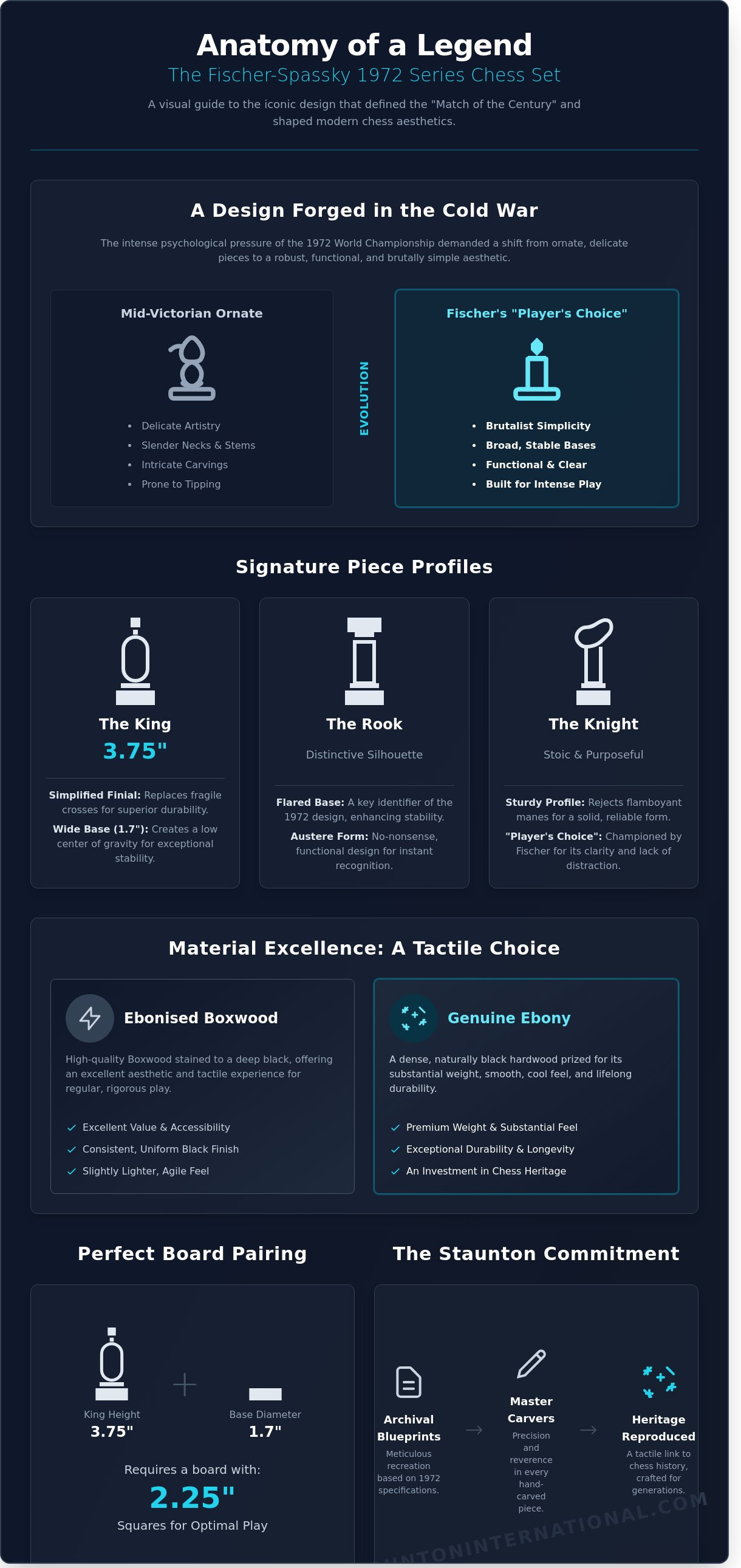
Choosing the right stage for your The Fischer Spassky Series Chess Pieces is a decision that requires both technical precision and an eye for historical accuracy. A King standing at 3.75 inches possesses a commanding presence, yet it requires a square size of exactly 2.25 inches to avoid a crowded or claustrophobic appearance on the rank. This ratio ensures that the base of the piece occupies enough of the square to feel stable while leaving sufficient space for the player’s fingers to navigate the board during a tense game. When the pieces are too large for their squares, the geometric clarity of the position is lost, which can be particularly distracting during complex tactical exchanges.
The visual weight of these pieces is unique. Because the 1972 design is famously stripped of unnecessary ornamentation, the wood grain of the board becomes a vital part of the visual narrative. Mahogany and maple are the traditional choices here, echoing the modernist aesthetic of the Laugardalshöll arena in Reykjavík. The deep, reddish hues of mahogany provide a striking contrast to the boxwood pieces, while the pale maple squares offer a clean, neutral backdrop that allows the silhouettes of the Knights and Bishops to stand out clearly. It’s about creating a balance where the board supports the pieces without competing for the viewer's attention.
To capture the quintessential 1970s atmosphere, one should look towards boards that prioritise clean lines and understated elegance. A satin finish is often preferred by serious collectors over a high-gloss coat. This is because satin reduces glare from overhead lighting, allowing the natural texture of the timber to speak for itself. You might also consider the width of the board's border. A frame that is too wide can overwhelm the minimalist carving of the pieces, whereas a slim, elegant border keeps the focus firmly on the 64 squares. Official Staunton recommends a board where the wood grain is consistent across the surface, ensuring that the natural patterns do not distract from the calculation of lines.
A set of this calibre is an investment in history, and its preservation relies heavily on how it is housed when not in use. Fitted boxes are the superior choice for the The Fischer Spassky Series Chess Pieces, as they provide individual slots that protect the delicate finials of the King and the sharp mitre of the Bishop from accidental chips. For those who appreciate an old-world feel, a slide-top box crafted from solid wood offers a tactile satisfaction that modern hinged alternatives often lack. Another factor worth considering is the environment. Wood is a living material that reacts to its surroundings; maintaining a stable humidity level within your storage area prevents the timber from cracking or warping over the decades. This careful stewardship ensures the set remains as pristine as the day it left the artisan's workshop.
Choosing the right accompaniments is not merely an act of utility; it is the final step in honouring the legacy of the most famous chess match in history. To find a board and box that meet these exacting standards, you can view our collection of professional playing sets.
Crafting a faithful reproduction of the equipment used in Reykjavik requires more than mere technical skill; it demands a deep appreciation for the 1972 aesthetic. Our master carvers spend weeks studying historical blueprints and high-resolution archival photography to ensure every knight's profile and every rook's crenellation mirrors the original design modified for the Spassky-Fischer era. This meticulous process bridges the gap between the 1849 Victorian origins and the mid-century evolution that defined the Cold War championship.
Every set undergoes a rigorous quality control phase where we inspect the grain of the Boxwood and Ebony for any natural imperfections. We ensure the triple-weighting is balanced perfectly, providing that authoritative thud on the board that grandmasters expect. If you're building a specific collection, our team provides a personalised service to help you find the exact proportions that suit your playing style and board size. You might wonder why we obsess over such minute details. It's because we believe The Fischer Spassky Series Chess Pieces should feel as significant in your hands as they did in the hands of the champions themselves.
Since our founding in 1993, Official Staunton has operated as more than a retailer. We see ourselves as custodians of a legacy, which you can learn more about in our About Us narrative. By supporting specialist UK-based manufacturers, we ensure that each of The Fischer Spassky Series Chess Pieces is treated as functional art. This dedication to craftsmanship preserves the intellectual prestige of the game for future generations. We don't just sell sets; we curate history.
Our relationship with a collector doesn't end when the box is delivered. We offer a unique ability to restore and revive historical reproductions that may have suffered wear over the decades. Because the Fischer Spassky series is designed to become a future antique, it deserves a lifetime of professional maintenance. Choosing a master chessman maker means you have access to a specialist who understands the soul of the wood and the history of the design. It's a partnership that lasts as long as the game itself.
Owning a set from this series is an investment in both history and future play. These pieces carry the weight of 1972 but are built for the rigours of modern study. Whether they sit prominently in a study or are used for daily analysis, they serve as a constant reminder of the 20th century's most significant chess moment. We invite you to experience the tactile luxury of a set that truly honours the 1972 legacy.
Selecting a fine playing set is an act of preservation for a design that defined the 1972 World Championship. Since 1993, our workshop has dedicated itself to capturing the exact weight and silhouette that Bobby Fischer famously demanded during his historic encounter in Iceland. You'll find that the balance of each piece reflects a deep understanding of traditional Staunton aesthetics, where the dense grain of the ebony meets the precision of hand-carved boxwood. It's this commitment to The Fischer Spassky Series Chess Pieces that ensures the soul of the Reykjavik match lives on in your own home.
These instruments aren't merely replicas; they're an invitation to participate in a legacy that has captivated minds for over five decades. Every knight's profile and every king's finial follows the authentic 1972 Reykjavik proportions to ensure your study or game room feels like a genuine piece of history. We take pride in our role as custodians of this craft, offering worldwide shipping to ensure these masterpieces reach serious collectors across the globe. It's a privilege to share this heritage with you, and we hope these pieces inspire your next great strategic victory.
Explore our exquisite Fischer Spassky Series and own a piece of chess history
The Fischer Spassky series chess pieces are distinguished by their robust, stout profiles and the absence of delicate, breakable finials. While a standard 1849 Staunton set often features slender stems and intricate carvings, this 1972 design prioritises stability and durability for high-stakes play. You'll notice the Knight's mane is carved with a distinctive, simplified elegance that reflects the modernist aesthetic of the early 1970s. It's a design built for the physical intensity of a championship match.
Yes, these pieces are perfectly suited for official tournament play because they adhere to the fundamental Staunton proportions required by FIDE. The 3.75-inch King height meets the standard competition regulations established for international events since the mid-20th century. Each piece is triple-weighted to ensure it remains stable on the board even during the frantic time scrambles often seen in competitive blitz or rapid matches. They provide the professional feel that serious players expect during a clock-timed game.
A board with 2.25-inch squares provides the ideal landscape for a King with a 3.75-inch height. This specific ratio ensures the pieces don't feel cramped, allowing approximately 76 percent of the square to be occupied by the King's base. Selecting a board with these dimensions maintains the visual harmony and spatial clarity necessary for calculating complex lines during a game. It's a configuration that mirrors the spatial arrangement used in the 1972 Reykjavik match.
You can identify ebonised boxwood by looking for subtle grain patterns or tiny brown highlights visible under a strong 100-watt light source. While genuine ebony is naturally dense and heavy, ebonised pieces are high-quality boxwood treated with a deep black stain to mimic the appearance of African timber. If you examine the base or any small chips, the pale natural wood of the boxwood will show through, whereas real ebony remains black throughout its entire structure. Both materials offer a beautiful finish for the Fischer Spassky series chess pieces.
The 1972 Reykjavik design broke away from Victorian fragility by introducing a reinforced aesthetic that could withstand the physical intensity of a World Championship. Its introduction coincided with the global chess fever of 1972, where over 500 million people followed the match between Bobby Fischer and Boris Spassky. The set's minimalist lines and thicker collars were a direct response to the need for equipment that felt substantial and modern on a global television stage. It redefined what a professional playing set should look like for the modern era.
Official Staunton maintains a dedicated archive of spare chessmen to ensure your set remains complete for decades. If a piece is lost or damaged, we provide individual replacements that are hand-turned and carved to match the specific dimensions of your existing series. It's a service that reflects our commitment to the longevity of your investment, ensuring the 32-piece army is always ready for battle. This peace of mind is essential for those who use their sets for daily study or play.
Cleaning your chessmen requires nothing more than a soft, lint-free microfibre cloth and a tiny amount of high-quality beeswax polish once every 12 months. Don't use chemical cleaners or water, as these can swell the wood grain or damage the delicate ebonised finish. Storing the pieces in a baize-lined wooden box at a consistent room temperature of 18 to 21 degrees Celsius will prevent the wood from cracking over time. Proper care ensures the timber retains its lustre for future generations.
Collectors value the Fischer Spassky series because it represents a pivotal moment in the 20th-century history of the game. As the 1972 match remains the most famous encounter in chess lore, high-quality recreations from established makers like Official Staunton tend to retain their value well. Owning a set that captures the exact specifications used in Reykjavik offers a tangible connection to the Cold War era's most significant intellectual struggle. It's a piece of history that functions as both a tool for play and a work of art.
